

Despite the current reformation of American policies and government in a divided world, we must not overlook its impact on our valuable mental health as a separate state from equality and social justice.
Bias is a quiet force, shaping our perceptions, influencing our decisions, and, too often, reinforcing the very divides we seek to overcome. It exists in all of us — subtle, ingrained, sometimes invisible. In today’s political climate, where polarization is at an all-time high, discussions about equality, social justice, and mental health are often met with resistance. Yet, these very principles are foundational to a thriving society.
Despite political rejection, dismissing these values does not erase their necessity. Instead, it creates greater instability, deepens suffering, and erodes the collective well-being we all depend on. Addressing bias and embracing these ideals is not just a moral choice but a practical one that leads to healthier individuals, stronger communities, and a more resilient world.
The Challenge of Bias
Bias — whether conscious or unconscious — creates barriers to fairness. It dictates who gets opportunities, who is heard, and whose struggles are validated. In a political climate that thrives on division, bias is often weaponized, turning critical issues into battlegrounds rather than areas for progress.
When left unchecked, bias undermines trust in institutions, limits access to resources, and creates environments where people are judged by stereotypes rather than their worth. It is easy to ignore bias when it does not affect us directly, but its consequences ripple outward, affecting society.
The Value of Equality
Equality does not mean sameness — it means ensuring everyone has access to the same opportunities and rights. A society that values equality creates pathways for people to contribute their talents and perspectives, fostering innovation and economic growth.
However, in an era where policies and rhetoric frequently prioritize exclusion over inclusion, the fight for equality faces significant resistance. The challenge is not just in creating fair laws but in changing mindsets, dismantling the fears that fuel inequality, and ensuring that all voices are given the space to thrive.
The Necessity of Social Justice
Social justice is about more than fairness — it is about actively correcting systemic inequities. It demands that we acknowledge historical wrongs and work toward a more just society. Yet, in a world that often resists accountability, conversations about justice are met with defensiveness and political backlash.
Despite this resistance, social justice remains essential. Without it, wealth, education, and healthcare disparities deepen, further destabilizing societies. The pursuit of justice is not about division but the shared responsibility to create a world where all people are valued and protected.
Mental Health: A Collective Priority
Mental health is not a luxury but a foundation for a functioning society. Yet, in politically charged debates, mental health often takes a backseat, seen as a personal issue rather than a societal one. When mental health is neglected, communities suffer from increased violence, addiction, and economic instability.
Prioritizing mental health means recognizing that stress, trauma, and psychological distress are real and deserve care, not stigma. Investing in mental health is an investment in a healthier, more productive society.
A Path Forward
Despite political pushback, embracing equality, social justice, and mental health is not just an ideological stance — it is a necessity. A society that values these principles is more stable, prosperous, and humane. The path forward is challenging, but progress has always come from those willing to stand firm in their values.
“Equality means more than passing laws. The struggle is won in the hearts and minds of the community, where it really counts.” — Barbara Gittings
The question is not whether we can afford to pursue these ideals — but whether we can afford not to.
Like what you’re reading? Want more consciously prepared brain food?
Listen to this Harvesting Happiness episode: Bias and Equality: Social Justice Impacting Mental Health with Jo-Ann Finkelstein PhD or wherever you get your podcasts.
Meet Our Guest:
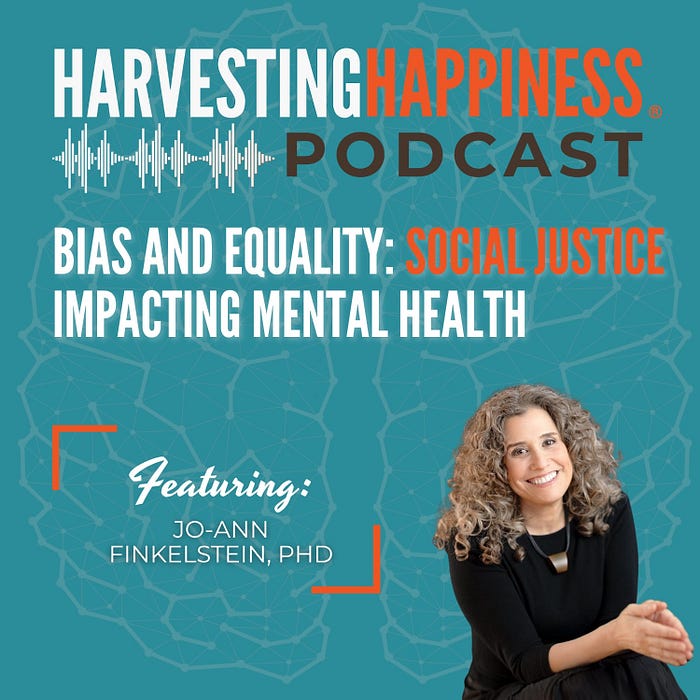
Dr. Jo-Ann Finkelstein PhD is a Harvard and Northwestern-trained clinical psychologist who integrates bias, social justice, and mental health in her private practice. She is featured in major outlets like The New York Times, Harvard Business Review, and CNN and contributes to Psychology Today. Active in women’s rights, she has served on the Chicago NOW board and helped organize the Chicago Women’s March.
Book: Sexism & Sensibility: Raising Empowered, Resilient Girls in the Modern World
Get More Mental Fitness bonus content by Harvesting Happiness on Substack and Medium.

Lisa Cypers Kamen is a lifestyle management consultant who explores the art and science of happiness in her work as a speaker, author, and happiness expert. Through her globally syndicated positive psychology podcast, books, media appearances, and documentary film, Kamen has impacted millions of people around the world.
About The Author
learn more
browse services