


A few weeks ago, I found myself in conversation with developmental psychologist Professor Niobe Way, whose groundbreaking work explores the intersection of culture, context, and human development. We were preparing for an upcoming panel at a conference when she posed a question that stopped me in my tracks: “Why do you think it’s so hard to get people to care about one another in today’s social climate?”
Without hesitation, I answered with a single word: FEAR.
Professor Way paused, then leaned forward. “You should tease that out,” she said. “There’s something important there.” Challenge accepted!
So I did. What follows is a two-part exploration of that hypothesis — why fear has become the dominant emotion shaping our cultural moment, how it spreads through our communities like a contagion, and why reclaiming our capacity to care might be the most radical and necessary act of our time.
I’ll admit, this isn’t exactly related to this week’s podcast theme. But it’s kind of, sort of part of the Venn diagram of what it means to be a good human — which, let’s be honest, is what all of this work is really about anyway.
In Part One, I examine how fear operates as a social contagion, creating an anti-social culture where caring becomes dangerous and empathy is pathologized. In Part Two, I make the case for why caring — despite the risks — is non-negotiable for our individual well-being, our collective survival, and our humanity itself
As a positive psychology researcher, I’ve spent years studying how emotions spread through social networks like wildfire. What I’m observing in our current cultural moment is perhaps the most significant example of emotional contagion I’ve witnessed in my career — and it’s rooted in fear. But before I explore how we got here, I need to make the case for why this matters so profoundly: because caring — for others and ourselves — isn’t just a nice virtue. It’s the foundation of our humanity, our health, and our survival as a species.
Why Caring Is Non-Negotiable for Human Flourishing
Let me be unequivocally clear about what decades of research in positive psychology, neuroscience, and social science reveal: we are hardwired to care, and when we suppress this fundamental capacity, we harm ourselves at the most basic biological and psychological levels.
“I feel the capacity to care is the thing which gives life its deepest significance.” — Pablo Casals
Caring isn’t optional — it’s how our brains developed, how our immune systems regulate, how we find meaning, and how we stay mentally healthy. When we care for others, our bodies release oxytocin, reduce cortisol levels, strengthen our immune function, and activate reward centers that make us feel purposeful and alive.
When we receive care, we experience safety, belonging, and the secure attachment that allows us to take risks, grow, and thrive. This isn’t sentiment — it’s science. We literally cannot be healthy humans without caring and being cared for.
Caring Is Our Evolutionary Superpower
What made humans the dominant species on this planet wasn’t our strength or speed — it was our unprecedented capacity for cooperation, empathy, and collective care. We survived because we cared for our sick, our elderly, and our vulnerable. We thrived because we could sense what others felt and coordinate our responses accordingly.
Every major human achievement — from language to medicine to space exploration — has emerged from our ability to care about problems beyond our immediate survival, to invest in future generations, and to extend empathy across boundaries. When we abandon caring, we don’t just lose a nice quality — we lose the very capacity that makes us distinctly human.
The Mental Health Imperative of Caring
From my research perspective, I can tell you that the absence of caring — both giving and receiving — is catastrophic for mental health. Social isolation and emotional disconnection are as deadly as smoking fifteen cigarettes a day.
Depression, anxiety, and substance abuse skyrocket when people feel they don’t matter to others or when they cannot express care without punishment. Meaning and purpose — the core components of psychological well-being — emerge almost exclusively from caring: caring for people, causes, ideas, or creative work.
“If you wish to experience peace, provide peace for another. If you wish to know that you are safe, cause another to know that they are safe. If you wish to better understand seemingly incomprehensible things, help another to better understand. If you wish to heal your own sadness or anger, seek to heal the sadness or anger of another.”– Dalai Lama
When we create cultures that suppress caring, we create epidemics of despair, suicide, and what researchers call “deaths of despair.” We cannot build a healthy society on apathy. It’s psychologically impossible.
The Research Is Clear: We Need to Care
Research is unambiguous: individuals who care for others tend to live longer, recover from illnesses more quickly, experience less depression, have stronger immune systems, and report higher life satisfaction.
Communities with strong, caring networks have lower crime rates, better health outcomes, greater economic mobility, and higher collective well-being. Caring for ourselves — practicing self-compassion — is equally essential. People who treat themselves with kindness during times of failure or difficulty exhibit greater resilience, lower anxiety, increased motivation to improve, and better relationships.
Self-care and other-care aren’t opposing forces — they’re complementary. When we care for others, we activate our own sense of purpose and connection. When we care for ourselves, we have the resources to extend care outward. Both are necessary. Both are healing.
Caring Is How We Solve Collective Problems
Every major challenge we face — climate change, public health, economic inequality, technological disruption — requires us to care about people we’ll never meet, including future generations. These problems cannot be solved by individuals protecting only their immediate tribe. They require the capacity to extend empathy beyond our in-group, to imagine the suffering of distant others, to invest in outcomes that may not benefit us personally.
A culture that punishes caring is a culture that cannot address existential threats. We need to care not just for our personal well-being but for our collective survival.
Check out the second part of this article next week. I’ll explore the troubling phenomenon I’m witnessing: how fear is spreading through our society like a contagion, dismantling our capacity to care, and creating what I call an “anti-social culture” where empathy itself becomes shameful. More importantly, I’ll share what gives me hope and practical pathways for making caring contagious again.
Like what you’re reading? Want more consciously prepared brain food?
Listen to this Harvesting Happiness episode: Communication Fix: Relationship Skills for Better Conversations and a Happy Life with Patricia Timerman Barbosa da Silva, PhD or wherever you get your podcasts.
Get “More Mental Fitness” bonus content by Harvesting Happiness on Substack and Medium.
Meet Our Guest:
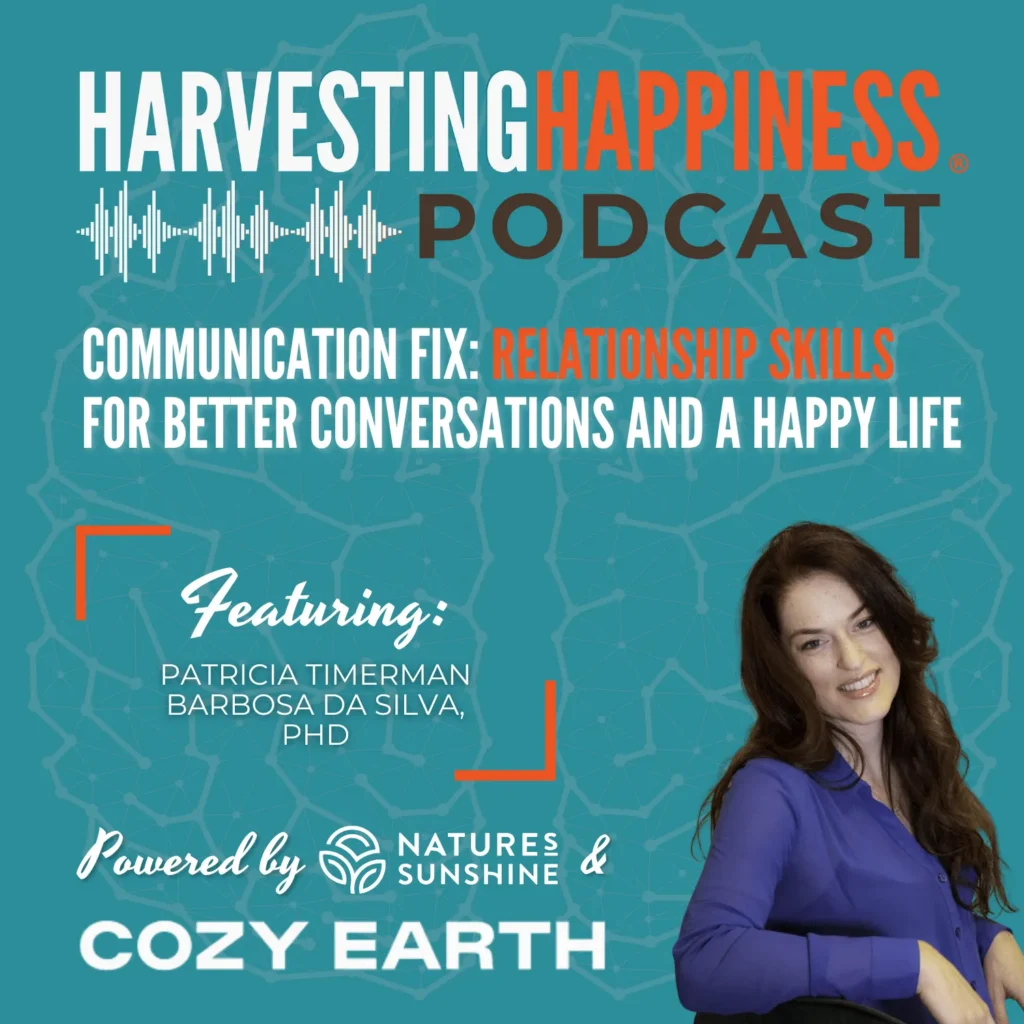
Dr. Patricia Timerman Barbosa da Silva PhD, aka “Dr. T,” is a psychotherapist, author, and founder of Advocate2Create. In her book, Why Are We Fighting?, she introduces the IAP Model — Intention, Action, Perception, a “Google Translate” for communication.
With over 12 years of experience, she specializes in grief, trauma, and couples therapy, integrating research-backed strategies to improve relationships. She also provides clinical evaluations for immigration cases, combining her mental health expertise with her background in immigration law.
Keep Reading:

Lisa Cypers Kamen is a lifestyle management consultant who explores the art and science of happiness in her work as a speaker, author, and happiness expert. Through her globally syndicated positive psychology podcast, books, media appearances, and documentary film, Kamen has impacted millions of people around the world.
About The Author
learn more
browse services