


As critical thinking seems increasingly rare and political discourse grows more polarized, the work of Hannah Arendt offers profound insights into how we might navigate our complex world with greater wisdom and humanity. This German-Jewish political theorist, who spent her final decades at Bard College, left us a treasure trove of ideas about thinking and loving the world.
Arendt’s writings advance our knowledge of the underlying principles of human society, which are remarkably applicable to contemporary leadership.
As a result of the Anschluss (the 1938 annexation of Austria into Nazi Germany), Aunt Christine and her family were displaced and stateless for a period of time. She is one of my favorite family elders. Christine died after 97 active years, during which she witnessed the emergence and decline of authoritarianism, its resurgence, and a reversal of our cultural landscape reminiscent of a dark era that many believed had ended. She introduced me to Hannah Arendt’s provocative writing.
The Revolutionary Mind: Hannah Arendt’s Journey from Exile to Intellectual Icon
Hannah Arendt’s life story reads like a testament to intellectual courage and fearless thinking. Born in 1906 in Germany, she witnessed the rise of totalitarianism firsthand, fled Nazi persecution, and eventually found refuge in America. Her personal experience of statelessness and displacement profoundly shaped her understanding of human dignity, political freedom, and what she called “the right to have rights.”
Arendt’s fearless thinking emerged from her refusal to accept conventional wisdom or partisan explanations for the political catastrophes of the twentieth century. She famously described her approach as “thinking without banisters”—abandoning traditional philosophical and political categories to examine phenomena with fresh eyes. This intellectual courage made her both influential and controversial, as she challenged both the left and the right with her penetrating analyses of democratic leadership and moral responsibility.
Her journey from a brilliant philosophy student studying under Martin Heidegger to becoming one of America’s most important political philosophers illustrates the power of independent thought in shaping our understanding of human affairs. At Bard College, where she taught from 1963 until her death in 1975, Arendt continued to develop her revolutionary ideas about politics, education, and the human condition.
Today, her intellectual legacy continues to thrive at Bard College through the Hannah Arendt Center for Politics and Humanities, directed by Roger Berkowitz. Under Berkowitz’s leadership, the Center has become a vital hub for contemporary engagement with Arendt’s ideas, hosting conferences, workshops, and public discussions that apply her thinking to current political and social challenges. The Center’s upcoming conference, JOY: Loving the World in Dark Times—A Common Inquiry (October 16-17, 2025, Olin Hall), exemplifies this ongoing commitment to making Arendt’s vision of amor mundi relevant to our contemporary struggles.
This conference will feature innovative perspectives on Arendt’s work. In my view, there is an aligned confluence between positive psychology and Arendt’s philosophy. I am excited to be a panel moderator at the upcoming conference and a proud collaborator with the Hannah Arendt Center at Bard College in spreading the valuable relevance of Arendt’s work as hope for humanity. This is an exciting and particularly promising avenue for me to explore how the science of well-being overlaps, illuminates, and can broaden Arendt’s insights about loving the world and finding meaning through political engagement and thoughtful action.
The Banality of Evil: Revolutionary Leadership Lessons for Modern Organizations
Perhaps no concept from Arendt’s work has had a greater impact on modern society than her notion of the “banality of evil.” Reporting on the trial of Adolf Eichmann in Jerusalem, Arendt observed that this architect of genocide was not a monster or fanatic but rather a thoughtless bureaucrat who failed to think critically about his actions.
“The sad truth is that most evil is done by people who never make up their minds to be good or evil.” – Hannah Arendt
This insight changed our understanding of how ordinary people can unwittingly become complicit in extraordinary evil due to thoughtlessness and conformity. Arendt’s analysis reveals how modern bureaucratic systems can enable moral blindness, making her work essential reading for today’s leaders grappling with organizational ethics and moral responsibility.
Revolutionary Leadership Principles from Arendt:
- Critical thinking as a moral imperative—Leaders must cultivate the habit of independent judgment and fearless thinking
- Questioning institutional pressures—Resist the tendency to “just follow orders” or accepted practices
- Personal responsibility in leadership—Recognize that position and expertise don’t exempt anyone from moral thinking
- Creating cultures of reflection—Foster environments where questioning and dissent are valued for organizational well-being
“Amor Mundi”: Loving the World Through Political Engagement
Central to Arendt’s philosophy is the concept of “Amor Mundi”—love of the world. For Arendt, this love isn’t sentimental but represents a deep commitment to preserving and renewing the common world we share with others. She argued that political action, at its best, emerges from this love and manifests as citizens working together to address shared challenges.
“Education is the point at which we decide whether we love the world enough to assume responsibility for it.” – Hannah Arendt
This idea offers a powerful bridge between political philosophy and positive psychology, connecting Arendt’s insights with contemporary well-being science. Loving the world means caring enough to engage while remaining open and curious to others’ perspectives and experiences—a principle that aligns with research on life satisfaction, flourishing, and civic well-being.
Modern Applications of “Amor Mundi” for Everyone:
- Civic engagement beyond voting—Participating in community organizations, local government, and public discourse
- Bridge-building across differences— Seeking common ground while respecting diverse viewpoints for organizational harmony
- Long-term thinking—Considering the world we leave for future generations in strategic planning
- Active citizenship in organizations—Taking responsibility for collective problems rather than leaving everything to experts or authorities
The Space of Appearance: Transforming Power and Authority in Modern Leadership
Arendt’s analysis of power fundamentally challenges conventional notions of leadership and authority. She distinguished between power (which emerges when people act together) and violence (which relies on force and coercion). True power, in her view, is not something individuals possess but rather something that emerges from collective action and disappears when people stop acting in concert.
“Power corresponds to the human ability not just to act but to act in concert. Power is never the property of an individual; it belongs to a group and remains in existence only so long as the group keeps together.” – Hannah Arendt
This insight has profound implications for modern leadership theories and practices. Authentic leadership, from an Arendtian perspective, involves creating conditions where collective power can emerge rather than simply imposing one’s will on others. Leaders become facilitators of shared action rather than commanders issuing orders.
Power-Building Leadership Strategies:
- Power-sharing over power-hoarding—Distributing authority and decision-making for better organizational outcomes
- Collaboration over command—Building consensus and shared purpose through democratic engagement
- Listening over lecturing—Creating spaces for diverse voices and perspectives in team dynamics
- Facilitating over controlling—Enabling others’ contributions rather than micromanaging for employee well-being
The Human Condition: Balancing Work, Meaning, and Well-Being
Arendt’s masterwork, “The Human Condition,” analyzes three fundamental activities of human life: labor, work, and action. Her insights into how modern society has elevated economic concerns over political engagement feel remarkably prescient in our current moment of technological disruption and social fragmentation.
She warned that when societies become too focused on consumption and production (labor and work) at the expense of political action, they risk losing the capacity for collective self-governance and meaningful public life. This analysis offers crucial insights for leaders grappling with work-life balance, organizational purpose, and employee engagement in the modern economy.
Practical Applications for Modern Living:
- Creating meaningful work—Connecting individual roles to larger purposes and values for well-being
- Encouraging innovation—Fostering environments where new ideas and approaches can emerge through critical thinking and creative problem-solving
- Building community—Developing practices that bring people together for shared purposes and civic engagement for the greater good
- Balancing efficiency with humanity—Recognizing that people need more than economic incentives to thrive.
Education and Leadership: The Crisis of Authority in Modern Times
Arendt’s essay, “The Crisis in Education,” speaks directly to contemporary debates about educational philosophy, institutional authority, and cultural transmission. She argued that education serves a conservative function—not in a political sense, but in the sense of conserving and passing on the world’s accumulated wisdom while preparing young people to renew and transform it.
This perspective provides helpful observations for leaders in educational institutions, corporations, and communities who struggle to strike a balance between tradition and innovation, mentorship and empowerment, and guidance and independence.
Leadership Insights for Modern Practice:
- Respecting accumulated wisdom while remaining open to new perspectives and critical thinking
- Modeling thoughtful engagement rather than just providing information for authentic leadership
- Creating structured freedom that provides frameworks within which creativity and initiative can flourish
- Connecting past and future to help people understand their inheritance and responsibility for loving the world
Practicing Arendtian Thinking and Applying Positive Psychology
The power of Hannah Arendt’s legacy lies not just in her theoretical insights but in their practical applications for everyday life and personal leadership development. Her work provides tools for navigating our complex world with greater wisdom, courage, and effectiveness, which are values in action synonymous with higher subjective well-being reports.
“The remedy against unpredictability, against the chaotic uncertainty of the future, is contained in the faculty to make and keep promises.” – Hannah Arendt
The practice of applied positive psychology guides us to those actions that make life worth living. Constructive thoughts, ideas, intentions, engagement, and actions generate a more satisfying life and society.
Daily Practices Inspired by Arendt’s Thinking and the Science of Well-Being:
- Regular reflection and questioning—Setting aside time to think critically about assumptions and conventional wisdom
- Engaging with diverse perspectives—Actively seeking out viewpoints that challenge your own thinking
- Participating in community life—Finding ways to contribute to shared projects and common concerns through positive relationships, connection, and engagement
- Reading and discussion—Engaging with challenging ideas through books, articles, and conversations about political philosophy and the importance of well-being for the greater good
- Moral imagination—Considering the broader implications and human consequences of decisions and actions
The Enduring Relevance of Fearless Thinking for Modern Society
As we face unprecedented global challenges—from climate change and technological disruption to political polarization and social inequality—Hannah Arendt’s example of fearless thinking becomes increasingly vital as a roadmap for the greater good. Her work reminds us that thinking is not a luxury for academics but a fundamental responsibility of anyone who wants to act wisely in the world.
At Bard College and beyond, Arendt’s influence continues to shape new generations of thinkers, leaders, and citizens. Her insights into the nature of power, responsibility, and human dignity provide essential tools for anyone seeking to understand and improve our shared world through political philosophy and applied positive psychology.
The legacy and challenge Arendt leaves us is to think courageously and love the world enough to engage with its problems thoughtfully and persistently. In a time when easy answers and tribal loyalties seem more appealing than difficult questions and complex truths, her example of intellectual courage offers both inspiration and practical guidance for creating a more thoughtful, just, and humane society.
By embracing Arendt’s approach to thinking without banisters, we can develop the mental agility and moral clarity necessary to navigate our rapidly changing world while preserving what is valuable from our collective inheritance. Her legacy challenges us to be not just consumers or producers, but active citizens and thoughtful human beings committed to the ongoing project of creating and sustaining a world worthy of our love.
Like what you’re reading? Want more consciously prepared brain food?
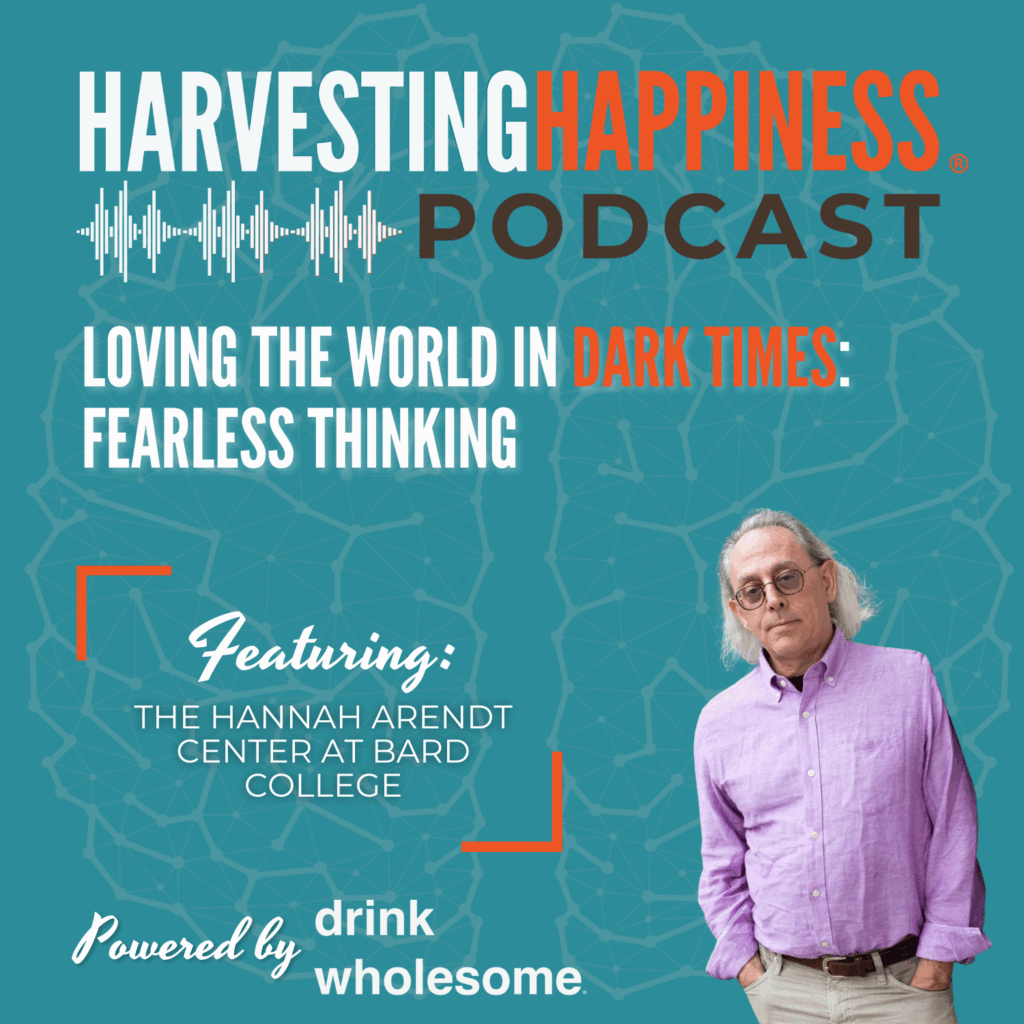
Listen to this Harvesting Happiness episode: Loving the World in Dark Times: Fearless Thinking from the Hannah Arendt Center at Bard College or wherever you get your podcasts.
This episode is proudly sponsored by Drink Wholesome—offering registered dietician-approved protein powders for sensitive stomachs made with simple, real food ingredients. Visit DrinkWholesome.com to learn more.
Get “More Mental Fitness” bonus content by Harvesting Happiness on Substack and Medium.
Meet Our Guest:
Roger Berkowitz is the Founder and Academic Director of the Hannah Arendt Center at Bard College, where he also serves as Professor of Politics, Philosophy, and Human Rights.
He is an award-winning author and editor who explores ethics, truth, and political thought, including The Gift of Science: Leibniz and the Modern Legal Tradition, and host of the podcast Reading Hannah Arendt with Roger Berkowitz.
Roger will publish his new book, A World We Share: The Power of Friendship in a Time Without Truth, in 2026.
The Hannah Arendt Center at Bard College will host the upcoming conference JOY: Loving the World in Dark Times (Thursday, October 16 and Friday, October 17, 2025, at Annandale-on-Hudson, NY).
Register to attend in person or online.

Resources for Further Exploration
Primary Works by Hannah Arendt
The Human Condition (1958)—Her masterwork on labor, work, and action
The Origins of Totalitarianism (1951)—Groundbreaking analysis of 20th-century political movements and democratic leadership
Eichmann in Jerusalem: A Report on the Banality of Evil (1963)—Revolutionary examination of moral responsibility in leadership
Between Past and Future (1961)—Essays on education, authority, and political crisis for modern leaders
On Revolution (1963)—A comparative study of American and French revolutions and political engagement
The Life of the Mind (1978)—Posthumously published work on thinking and willing for critical thinking development
Biographical Resources for Understanding Her Leadership Philosophy
Hannah Arendt: For Love of the World by Elisabeth Young-Bruehl—Definitive biography
Why Arendt Matters by Elisabeth Young-Bruehl—Accessible introduction to her relevance for modern leadership
Hannah Arendt: A Life in Dark Times by Anne C. Heller—Recent comprehensive biography
Hannah Arendt: Facing Tyranny (2025) PBS documentary film—Insights into the human condition, the refugee crisis, and totalitarianism
Institutional Resources for Continued Learning
Hannah Arendt Center for Politics and Humanities at Bard College—Under the direction of Roger Berkowitz, the Center continues Arendt’s mission through ongoing programs, conferences, and research initiatives. The HAC provides an intellectual space for passionate, uncensored, and nonpartisan thinking that reframes and deepens the fundamental questions facing our nation and our world.
Reading Hannah Arendt with Roger Berkowitz podcast
Keep Reading:

Lisa Cypers Kamen is a lifestyle management consultant who explores the art and science of happiness in her work as a speaker, author, and happiness expert. Through her globally syndicated positive psychology podcast, books, media appearances, and documentary film, Kamen has impacted millions of people around the world.
About The Author
learn more
browse services