


I am a serial monogamist. I have been mated for most of my life in relationships of long duration. Once in a blue moon, I engage in the thought experiment about dating in the digital age. From girlhood to wisdom years, the world has changed!
The way we find love has fundamentally changed. A generation ago, most couples met through friends, at work, or in their communities. Today, online dating has become the most common way couples meet, with nearly forty percent of heterosexual couples and over sixty percent of same-sex couples connecting through digital platforms. Artificial intelligence now curates potential matches, suggests conversation starters, and even predicts compatibility. We are witnessing nothing less than a revolution in how humans form intimate connections.
Dr. Justin Garcia, a leading researcher at the Kinsey Institute and author of The Intimate Animal, has been studying this digital transformation of intimacy. His research explores how technology amplifies certain aspects of human mating psychology while creating entirely new challenges. From the paradox of choice on dating apps to the promise and peril of AI-assisted romance, we are navigating uncharted territory in the landscape of love.
I am excited to share about the influence of digital technology on contemporary dating habits, the role of artificial intelligence in matchmaking and relationship navigation, and what the future might hold for human connection in an increasingly mediated world. Drawing on recent research and Dr. Garcia’s expertise, we explore both the opportunities and challenges of finding love in the digital age.
The Dating App Revolution: How Digital Platforms Changed Courtship
Dating apps have fundamentally restructured the landscape of romantic possibility. What was once limited by geography and social networks now spans entire cities or even countries. A single person in New York can swipe through hundreds of potential matches in an evening—a scale of choice unprecedented in human history.
This abundance creates what psychologists call the paradox of choice. While more options seem desirable, research shows that excessive choice can lead to decision paralysis, lower satisfaction, and increased second-guessing. On dating apps, this manifests as endless swiping without committing, constantly wondering if someone better is just one swipe away.
Dr. Garcia’s research reveals that digital dating platforms amplify certain aspects of human mating psychology. We make rapid judgments based on limited information—a tendency that served our ancestors well but can lead to superficial decisions in modern contexts. Physical appearance, which can be assessed instantly from photos, often dominates initial selection, while qualities like kindness, humor, and compatibility require sustained interaction to evaluate.
The gamification of dating apps—with their swipe mechanics, match notifications, and reward schedules—taps into dopamine-driven motivation systems. This creates an engaging user experience but can also lead to addictive patterns of use. Some users report spending hours swiping without actually going on dates, treating the app as entertainment rather than a tool for connection.
Yet digital platforms also democratize access to romantic possibilities. People who face barriers in traditional dating venues—due to geography, social anxiety, minority status, or physical disabilities—often find online dating more accessible. LGBTQ individuals, in particular, have benefited enormously from digital platforms that allow them to find community and potential partners beyond their immediate physical environment.
The Psychology of Online Dating: Attraction in the Digital Realm
Online dating psychology differs in important ways from face-to-face courtship. When we meet someone in person, we process multiple streams of information simultaneously—body language, voice tone, pheromones, and contextual cues. Online, we construct impressions from curated profiles, carefully selected photos, and text-based communication.
Research on online self-presentation reveals that most people engage in some degree of strategic impression management. This is not necessarily deception—rather, people highlight their best qualities while downplaying less attractive aspects. The challenge comes when online personas diverge significantly from reality, leading to disappointment at first meetings.
Text-based communication in early online interactions creates unique dynamics. Without nonverbal cues, people rely heavily on message timing, emoji use, and writing style to interpret interest and compatibility. Miscommunication is common, as text lacks the emotional nuance of voice and expression. Yet text-based communication can also facilitate deeper disclosure, as some people find it easier to share vulnerabilities through writing than face-to-face conversation.
The transition from online to offline remains a critical juncture. Research shows that chemistry felt through messaging does not always translate to in-person attraction. Voice, smell, physical presence, and interpersonal synchrony—all absent in text-based communication—play important roles in romantic attraction. This explains why some promising online connections fizzle after meeting in person.
Dating app fatigue has emerged as a recognized phenomenon. The emotional labor of maintaining multiple conversations, the disappointment of connections that go nowhere, and the objectification inherent in swipe-based selection take psychological tolls. Many users cycle through periods of intense app use followed by breaks or deletion, reflecting ambivalence about digital dating.
Algorithms of Love: How AI Matchmaking Works
Artificial intelligence has become increasingly central to online dating. Modern platforms use sophisticated algorithms to curate matches, predict compatibility, and personalize user experiences. Understanding how these systems work—and their limitations—is essential for navigating digital dating successfully.
Dating algorithms typically combine collaborative filtering—showing you people similar to those you’ve liked before—with content-based filtering that matches stated preferences. Machine learning models analyze thousands of data points: which profiles you view, how long you look at photos, message response rates, and patterns in successful matches across the platform.
Some platforms claim to predict long-term compatibility using personality assessments and matching algorithms. While these systems can identify surface-level compatibility on measured dimensions, research suggests that algorithmic matchmaking does not reliably predict relationship success. The qualities that sustain long-term relationships—communication skills, conflict resolution, shared values, commitment—are difficult to measure through questionnaires and impossible to predict from profile data alone.
AI systems also introduce biases that users should understand. Algorithms optimize for engagement, not necessarily for finding meaningful connections. They may show you attractive people you’re unlikely to match with because those profiles keep you swiping. They may reinforce existing preferences—including problematic ones like racial bias—rather than challenging them. The apparent objectivity of algorithmic matching masks subjective design choices about what the system values and optimizes for.
Transparency in algorithmic matchmaking remains limited. Most platforms treat their algorithms as proprietary secrets, leaving users to guess at how matches are selected. This opacity makes it difficult to use these tools strategically or to understand why certain people appear in your queue while others do not.
AI Dating Coaches and Relationship Tools: The Rise of Algorithmic Advisors
Beyond matchmaking, AI is increasingly being used to coach users through dating and relationship challenges. Chatbots offer profile optimization advice, suggest conversation topics, analyze message tone, and even help compose opening lines. Some tools claim to predict whether a relationship will succeed based on communication patterns.
AI conversation assistants represent a particularly interesting development. These tools analyze your messaging history and suggest responses designed to maintain interest, display confidence, or create an emotional connection. Some users find these tools helpful for overcoming social anxiety or improving communication skills. Critics worry that they can create inauthentic interactions and outsource the very vulnerability that creates genuine connection.
Photo enhancement and selection tools use AI to identify which images are most likely to generate matches. These algorithms analyze facial expressions, body positioning, backgrounds, and styling to predict attractiveness ratings. While this may increase match rates, it also reinforces narrow beauty standards and encourages strategic self-presentation over authentic self-disclosure.
Relationship maintenance apps have emerged, offering AI-powered advice for ongoing partnerships. These tools prompt users to express appreciation, suggest date ideas based on shared interests, and identify potential relationship issues based on communication patterns. While potentially helpful as reminders and prompts, they risk outsourcing emotional labor and reducing intimate connection to algorithmic optimization.
The fundamental question is whether AI can genuinely improve human connection or whether it introduces a problematic layer of mediation between people. Dr. Garcia’s research suggests that technology works best when it facilitates authentic human interaction rather than replacing it. Tools that reduce barriers to connection—helping people overcome anxiety, expand their social circles, or communicate more effectively—can be valuable. Those that automate intimacy itself may undermine the vulnerability and risk-taking essential to deep relationships.
The Dark Side of Digital Dating: Safety, Deception, and Exploitation
While digital dating creates opportunities, it also introduces risks. Catfishing—creating fake profiles to deceive others—exploits the anonymity and distance inherent in online interaction. Romance scams cost victims hundreds of millions of dollars annually. Harassment, from unsolicited sexual messages to stalking and threats, plagues many users, particularly women.
Safety concerns affect how people use dating platforms. Many users, especially women, develop elaborate screening strategies to identify potentially dangerous matches. First dates in public places, telling friends about meetings, and conducting background searches have become standard precautions. While platforms have implemented some safety features—photo verification, in-app video calling, integration with emergency services—risks remain.
Digital dating also enables more subtle forms of problematic behavior. Ghosting—ending contact without explanation—has become normalized in online dating contexts in ways that would be considered unacceptably rude in face-to-face interaction. Breadcrumbing—maintaining minimal contact to keep someone interested without commitment—exploits the asynchronous nature of digital communication.
The commodification of human connection represents another concern. When people are presented as profiles to evaluate and swipe through, there’s a risk of treating potential partners as consumable products rather than whole human beings. This objectification can spill over into how people approach relationships, emphasizing the acquisition of desirable traits over the appreciation of uniqueness.
Mental health implications of digital dating deserve serious attention. Research links heavy dating app use with lower self-esteem, increased anxiety and depression, and reduced overall well-being in some users. The constant evaluation—being judged and judging others based on appearance—can damage body image and self-worth. For those already struggling with rejection sensitivity or social anxiety, the high rejection rate inherent in online dating can be particularly harmful.
Beyond Dating Apps: Technology’s Broader Impact on Relationships
Technology’s influence on relationships extends far beyond initial matchmaking. How couples communicate, manage conflict, maintain long-distance relationships, and integrate technology into daily life affects relationship quality and satisfaction.
Constant connectivity creates new relationship dynamics. Partners expect rapid responses to messages, leading to anxiety when communication delays occur. The always-on nature of smartphones means work, social media, and external demands constantly intrude on couple time. Research shows that phubbing—snubbing a partner to check your phone—predicts lower relationship satisfaction.
Social media introduces unique challenges to modern relationships. Maintaining connections with ex-partners, receiving attention from potential alternatives, and comparing one’s relationship to curated portrayals of others’ partnerships can create jealousy and dissatisfaction. The public nature of relationship status—who posts about whom, whose photos appear together—adds performative pressure to intimate connections.
Technology also enables new relationship forms. Long-distance relationships, once limited by expensive phone calls and delayed letters, can now maintain daily video contact and constant messaging. My partner and I maintained a very strong and satisfying long-distance relationship for over ten years before landing under the same roof. While geographic separation still presents challenges, technology makes these relationships more viable than ever before. Virtual intimacy—from sexting to video sex—has become a normal part of how couples maintain connection across distance.
The key to healthy technology use in relationships appears to be intentionality. Couples who establish boundaries around device use, create tech-free quality time, and use technology to enhance rather than replace face-to-face connection report higher satisfaction. Technology is neither inherently good nor bad for relationships—its impact depends on how thoughtfully it is integrated into our coupled lives.
The Future of Digital Intimacy: Emerging Technologies and Relationship Science
The pace of technological change suggests that current digital dating practices represent merely an early phase of technology’s integration into human intimacy. Emerging technologies—virtual reality, artificial intelligence, brain-computer interfaces—promise to transform relationships in ways we can only begin to imagine.
Virtual reality dating already exists in early forms. Users create avatars and meet in virtual spaces, interacting through voice and movement. While currently niche, VR could address some limitations of text-based online dating by incorporating nonverbal communication while maintaining geographic flexibility. However, VR also raises questions about identity, authenticity, and the boundaries between virtual and physical intimacy.
AI companions represent perhaps the most provocative development. Chatbots designed to provide emotional support, companionship, and even romantic interaction are becoming increasingly sophisticated. Some users develop strong attachments to AI companions, raising philosophical questions about the nature of relationships and whether human-AI connections can satisfy fundamental needs for intimacy.
Dr. Garcia’s perspective emphasizes that technology will continue to shape but not replace fundamental human needs for connection. While the forms of courtship and relationship may change dramatically, the underlying motivations—the desire for intimacy, belonging, sexual connection, and shared meaning—remain constant. The challenge is ensuring that technology serves these human needs rather than distorting or commodifying them.
Neuroscience and relationship science will likely converge with technology in the coming years. Imagine dating platforms that incorporate biometric data—stress responses, arousal patterns, emotional states—to assess compatibility. While this could provide unprecedented insight into attraction and compatibility, it also raises profound ethical questions about consent, privacy, and the reduction of human complexity to measurable data.
The future may also bring greater integration of relationship support technology into ongoing partnerships. AI relationship coaches, conflict resolution tools, and compatibility monitoring could become standard features of committed relationships. Whether this represents helpful support or inappropriate intrusion into intimate spaces remains an open question.
Navigating Digital Dating Wisely: Evidence-Based Strategies
Given the reality that digital platforms are now central to how people meet romantic partners, what does research suggest about using them effectively? Dr. Garcia and other relationship scientists offer several evidence-based recommendations for navigating digital dating successfully.
First, approach dating apps as tools rather than games. Set clear intentions about what you seek—casual dating, serious relationship, specific connection types—and use platforms that align with those goals. Resist the gamified features designed to maximize time spent swiping rather than actually connecting with people.
Second, move from app to in-person meeting relatively quickly. Extended messaging before an “IRL” meeting can create unrealistic expectations and waste time with mismatches. Research suggests that meeting within a week or two of initial matching leads to better outcomes than prolonged online-only interaction.
Third, maintain realistic expectations about algorithmic matchmaking. While platforms can introduce you to people you might not otherwise meet, they cannot reliably predict relationship success. Compatibility develops through interaction, not profile analysis. Stay open to people who may not seem like perfect matches on paper.
Fourth, practice authentic self-presentation. While some strategic highlighting of positive qualities is normal, significant misrepresentation creates problems when transitioning to in-person interaction. Present yourself as you actually are—including photos that accurately represent your current appearance—to attract people genuinely compatible with the real you.
Fifth, protect your mental health. Set boundaries around app use time, take breaks when dating feels exhausting, and remember that rejection is inherent to the process and not a reflection of your worth. If digital dating consistently damages your wellbeing, consider whether it’s the right approach for you.
Sixth, maintain safety awareness. Meet in public places, tell friends about dates, trust your instincts about concerning behavior, and report problematic users to platforms. Your safety is more important than avoiding awkwardness or giving someone the benefit of the doubt.
The Human Element: Why Technology Cannot Replace Authentic Connection
Despite all the technological innovation in dating and relationships, research consistently shows that fundamental human qualities determine relationship success. Emotional intelligence, communication skills, empathy, commitment, and the ability to navigate conflict matter far more than how people meet or which apps they use.
Technology can facilitate meeting potential partners, but it cannot create chemistry, build trust, or sustain intimacy. Those emerge from vulnerable self-disclosure, shared experiences, mutual support through challenges, and the countless small moments of connection that accumulate over time. No algorithm can shortcut the work of building a healthy relationship.
Dr. Garcia emphasizes that we remain, fundamentally, intimate animals whose needs for connection are shaped by evolutionary history, not technological innovation. While we adapt to new tools for finding and maintaining relationships, our core psychology—the desires, fears, and capacities that define human intimacy—remains constant.
The risk is that technology’s efficiency and convenience can make us forget that meaningful relationships require inefficiency—time spent together without purpose, conversations that meander, conflicts that demand patient navigation. The messiness of human connection cannot be optimized away without losing something essential.
Ultimately, technology is best understood as a tool that can enhance or hinder human connection depending on how we use it. When it helps us overcome barriers, expand possibilities, and communicate more effectively, it serves human flourishing. When it replaces authentic interaction, reduces people to data points, or creates addictive patterns that substitute for real relationships, it works against our deepest needs.
Embracing Technology While Honoring Human Nature
We stand at a unique moment in human history, where technology has fundamentally altered how we form intimate connections. Online dating, AI matchmaking, and digital communication tools have created unprecedented access to potential partners while introducing new challenges to authentic relationship formation.
Dr. Justin Garcia’s research reminds us that beneath these technological changes, human psychology remains remarkably consistent. We still seek love, desire sexual connection, form attachments, and need intimate relationships for well-being. Technology changes the context in which these timeless needs play out, but it does not change the needs themselves.
The future will undoubtedly bring even more sophisticated tools for facilitating and mediating human connection. Virtual reality dating, AI companions, neuroscience-based compatibility testing—these are not distant possibilities but emerging realities. How we integrate these technologies into our intimate lives will shape the future of human relationships.
The key is maintaining intentionality about technology use. We must ask not just whether a tool is technically possible, but whether it serves human flourishing. Does this technology facilitate authentic connection or replace it? Does it expand possibilities or create new forms of exploitation? Does it enhance our capacity for intimacy or diminish it?
By combining insights from relationship science with thoughtful engagement with technology, we can navigate this new landscape wisely. We can use digital tools to meet people we might never encounter otherwise while maintaining the vulnerable, messy, human work of building real relationships. We can appreciate algorithmic assistance while recognizing that the qualities that make relationships thrive—trust, communication, commitment, empathy—cannot be automated.
In the end, technology changes how we meet and communicate, but not why we seek connection or what makes relationships meaningful. As we continue integrating digital tools into our intimate lives, keeping this perspective grounded in relationship science and human psychology will help us preserve what matters most: our capacity for deep, authentic, life-enriching connections with others.
Like what you’re reading? Want more consciously prepared brain food?
Listen to this Harvesting Happiness episode: From Algorithms to Intimacy: AI and Mating in the Digital Age with Dr. Justin Garcia, PhD or wherever you get your podcasts.
Get “More Mental Fitness” bonus content by Harvesting Happiness on Substack and Medium.
Enjoying this theme? Be sure to also check out Part I of the conversation with Dr. Just Garcia: The Biology of Bonding: Understanding Human Sexuality (hyperlink to episode)
Resources for Further Exploration:
- The Intimate Animal: The Science of Sex, Fidelity, and Why We Live and Die for Love by Dr. Justin Garcia—Explores evolutionary biology, neuroscience, and the science behind human intimacy
- Attached: The New Science of Adult Attachment and How It Can Help You Find—and Keep—Love by Amir Levine and Rachel Heller—Essential guide to attachment theory in relationships with practical applications
- The Seven Principles for Making Marriage Work by John Gottman and Nan Silver—Evidence-based strategies from decades of relationship research – the gold standard
- Come As You Are: The Surprising New Science That Will Transform Your Sex Life by Emily Nagoski— Groundbreaking research on sexuality, desire, and pleasure
- Modern Romance by Aziz Ansari and Eric Klinenberg—Sociological research on how technology has transformed dating culture
- Why We Love: The Nature and Chemistry of Romantic Love by Helen Fisher—Neurobiological and anthropological perspectives on the science of love
Meet Our Guest:
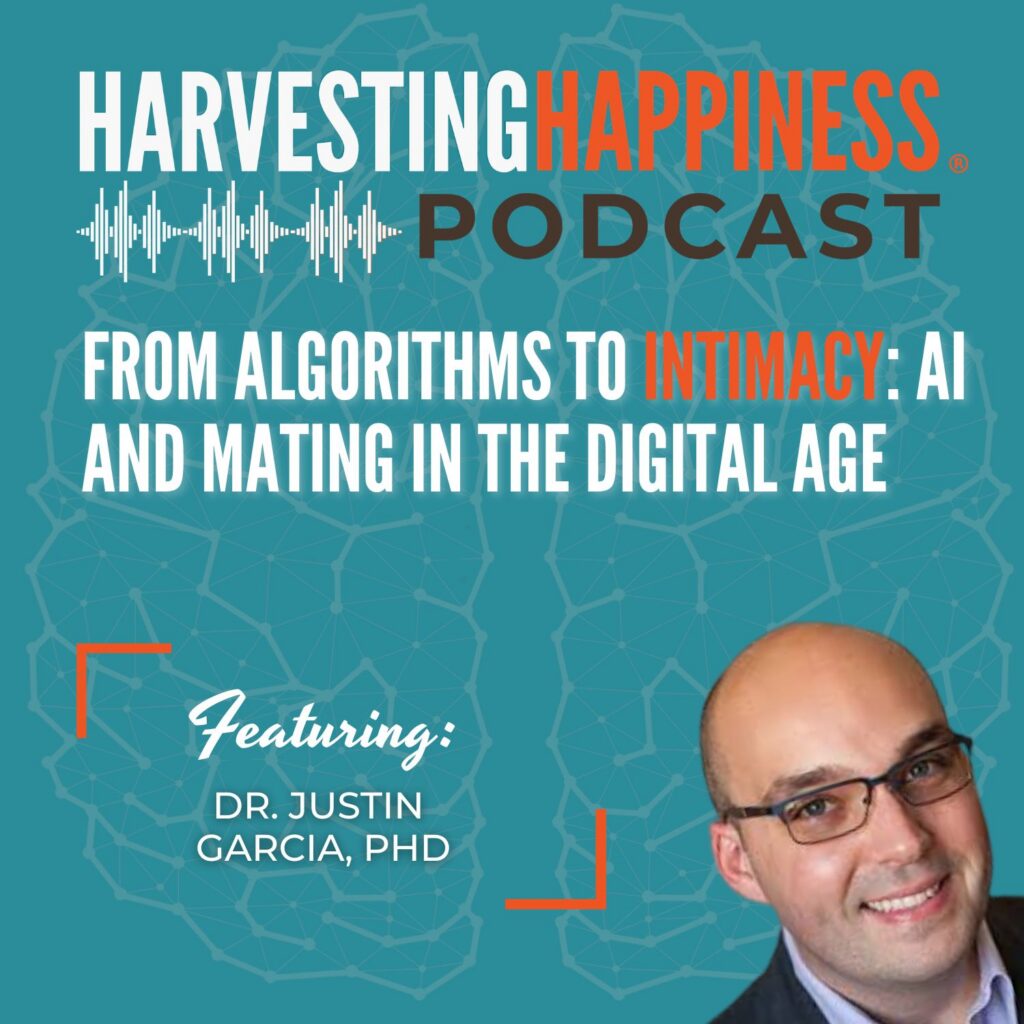
Dr. Justin R. Garcia, PhD, is Executive Director of The Kinsey Institute and Ruth Halls Professor of Gender Studies at Indiana University, Bloomington. An award-winning researcher and educator, Dr. Garcia’s research focuses on people’s romantic and sexual lives throughout the life course, especially on integrative bio-psycho-social models of variation in courtship, intimacy, and sexual behavior.
He has co-authored over 100 academic articles and book chapters, and is co-author of Evolution and Human Sexual Behavior (Harvard University Press). Since 2010, he has been Scientific Advisor to the world’s largest relationship company, Match.com.
Book: The Joy Reset: Six Ways Trauma Steals Happiness and How To Win It Back
Keep Reading:

Lisa Cypers Kamen is a lifestyle management consultant who explores the art and science of happiness in her work as a speaker, author, and happiness expert. Through her globally syndicated positive psychology podcast, books, media appearances, and documentary film, Kamen has impacted millions of people around the world.
About The Author
learn more
browse services