


We like to believe we leave our childhoods behind. We grow up, move out, build careers, start families—and carry every unexamined wound right along with us. Emotional baggage is not a metaphor. It is a living inheritance, passed down through modeling, neglect, and the slow accumulation of unprocessed pain. And it permeates everything.
I’ve witnessed this in my immediate family. It is destructive, non-productive, and simply sad.
What Is Emotional Baggage, Really?
“Emotional baggage” refers to the unresolved trauma, painful memories, and maladaptive patterns we absorb from adverse early experiences—particularly within our families of origin. When we grow up in environments defined by conflict, neglect, emotional unavailability, addiction, or abuse, we don’t simply endure those conditions. We internalize them as our template for how the world works and how relationships function.
The result is impaired emotional intelligence: an underdeveloped capacity to identify, regulate, and communicate our feelings. Without that foundation, navigating adult life becomes an exhausting exercise in unconscious reactivity. And sadly, we often don’t recognize it until the damage is already done.
The Relationship Toll
Nowhere is emotional baggage more corrosive than in our close relationships. When we are raised in high-adversity households, we often struggle to establish healthy boundaries, tolerate vulnerability, or resolve conflict without escalation. We may oscillate between emotional unavailability and emotional flooding. We may confuse intensity with intimacy or chaos with connection—because that is all we were ever shown.
Poor self-regulation becomes the fault line through which our relationships crack. Trust erodes. Resentment accumulates. The people we love most absorb the secondary weight of wounds we haven’t yet named, often without any of us fully understanding why.
The Professional and Social Ripple Effect
Our unresolved emotional wounds don’t clock out at the end of the workday. In professional settings, emotional baggage surfaces as difficulty with authority, poor collaboration, hypersensitivity to feedback, or recurring conflict with colleagues. When we lack self-mastery—the capacity to direct our behavior toward our actual values and goals—we undermine our own ambitions and erode the trust of those around us.
Our social lives suffer similarly. Friendship requires reciprocity, attunement, and the ability to repair after rupture. When we haven’t developed those skills, our connections remain shallow, volatile, or simply don’t last.
Unnecessary Drama as a Symptom
One of the most recognizable hallmarks of collective emotional baggage is the persistent generation of unnecessary drama and suffering—not as a conscious choice, but as a default. When dysregulation is our baseline, conflict feels familiar. Calm feels suspicious. Chaos becomes the only relational language available to us, and we pass it forward without meaning to.
The Path Forward
Recognizing emotional baggage is not an act of blame. It is an act of clarity and, ultimately, of compassion. When we commit to honest self-examination and supported healing, we don’t just transform our own lives. We interrupt inherited patterns before they reach the next generation. Emotional well-being is not a luxury. It is the infrastructure of a life well and fully lived.
This just might be the prescription for a more productive society. Imagine that…
Resources for Further Exploration
Books:
- The Body Keeps the Score by Bessel van der Kolk, MD, is THE foundational text on how trauma lives in the body and reshapes the nervous system
- Adult Children of Emotionally Immature Parents by Lindsay C. Gibson, PsyD, is an essential read for anyone whose parents lacked emotional availability
- Complex PTSD: From Surviving to Thriving by Pete Walker is a practical, compassionate guide to healing from chronic childhood trauma
- Attached by Amir Levine & Rachel Heller explores attachment theory made accessible, explaining how early bonds shape adult relationships
- Running on Empty by Jonice Webb, PhD, illuminates emotional neglect and the invisible wounds that don’t always have a name
Like what you’re reading? Want more consciously prepared brain food?
Listen to this Harvesting Happiness episode: How to Release Emotional Baggage and Create Secure, Lasting Relationships with Jessica Baum, LMHC or wherever you get your podcasts.
Get More Mental Fitness bonus content by Harvesting Happiness on Substack and Medium.
Meet Our Guest:
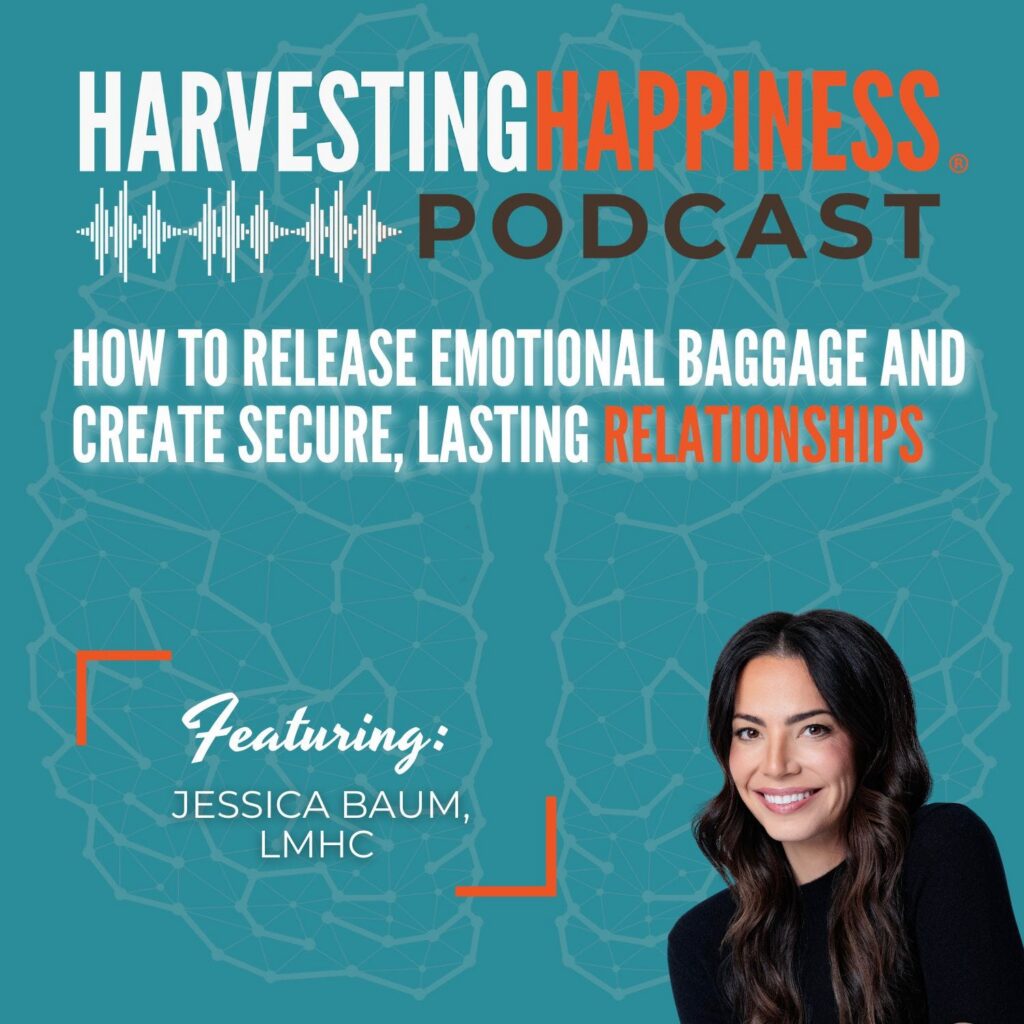
Jessica Baum, LMHC, is a licensed therapist and the author of Anxiously Attached. As the founder of the Relationship Institute of Palm Beach and the Conscious Relationship Group, she supports individuals and couples worldwide in forming healthy, long-term relationships through online coaching and transformational courses.
Born and raised in Manhattan, she now lives in West Palm Beach, Florida.
Baum’s latest book is Safe: An Attachment-Informed Guide to Building More Secure Relationships
Keep Reading:

Lisa Cypers Kamen is a lifestyle management consultant who explores the art and science of happiness in her work as a speaker, author, and happiness expert. Through her globally syndicated positive psychology podcast, books, media appearances, and documentary film, Kamen has impacted millions of people around the world.
About The Author
learn more
browse services