

At some point in our lives, every one of us will encounter trauma.
This past year has been a stark reminder. Between my mother’s sudden death, the health crises of other immediate family members, and complicated family dynamics, I am reminded how trauma can disrupt everything.
Sometimes it arrives like a lightning strike—a sudden accident, a loss, a diagnosis. Other times, it seeps in quietly through chronic stress, emotional neglect, relational betrayal, or years of feeling unseen. It may not make headlines. It may not even look dramatic from the outside. But internally, something shifts.
Trauma is not rare. It is part of the human experience.
And while trauma can fracture us, it can also refine us. When we understand the “nature of trauma”, how it impacts our minds and bodies, and how meaning can emerge in its aftermath, we begin to move from survival mode into conscious healing.
What Do We Mean by Trauma?
Trauma occurs when an experience overwhelms our nervous system and exceeds our ability to cope. It is less about the objective severity of an event and more about our internal sense of helplessness, fear, or lack of safety.
Two people can go through the same event—a divorce, job loss, public embarrassment, medical crisis—and one may integrate the experience while the other develops lingering trauma symptoms. Trauma is not a measure of strength or weakness. It is a reflection of how our nervous system processed what happened.
As trauma psychiatrist Bessel van der Kolk explains in The Body Keeps the Score, trauma is stored not only as memory but as physiology. It lives in muscle tension, stress hormones, breath patterns, and startle responses.
- Acute trauma: a single distressing event
- Chronic trauma: repeated or prolonged exposure to stress
- Complex trauma: layered relational harm, often over time
- Developmental trauma: early childhood adversity
Many of us also carry “small t” traumas—repeated dismissals, subtle humiliations, chronic pressure, emotional neglect. Individually, they may seem minor. Collectively, they can profoundly shape our beliefs about ourselves and the world.
We do not need to compete over whose trauma was worse. We only need to acknowledge what shaped us.
How Trauma Rewires the Brain
When trauma strikes, our brains prioritize survival.
The amygdala helps us to process emotions and assess threats. The prefrontal cortex, responsible for rational thinking and impulse control, may go partially offline. The hippocampus, which organizes memory into coherent narratives, may fragment the experience into sensory impressions—smells, sounds, flashes.
Trauma reorganizes the brain around protection and survival.
This explains why we may react strongly to seemingly small triggers. A tone of voice, a smell, or a look can activate our stress response before we consciously understand why.
Our nervous systems shift into fight, flight, freeze, or fawn responses:
- Fight: irritability, anger, defensiveness
- Flight: anxiety, overworking, restlessness
- Freeze: numbness, shutdown, procrastination
- Fawn: people-pleasing, conflict avoidance
These are not character flaws. They are adaptive strategies. At some point, they kept us safe.
As somatic trauma expert Peter A. Levine describes in Waking the Tiger, trauma is not what happens to us—it is what gets stuck in our nervous systems when our survival energy has no safe outlet.
Healing begins when we help the body complete what it once had to suppress.
Trauma in the Body: The Stress Loop
Trauma is deeply connected to chronic stress.
Repeated activation of the stress response floods our bodies with cortisol and adrenaline. Over time, this can disrupt sleep, digestion, immunity, cardiovascular health, and mood regulation. Many symptoms labeled as “mystery illnesses” have roots in unresolved stress activation.
This is why high-search topics like:
- Nervous system regulation techniques
- Trauma recovery tools
- Mind-body healing practices
- Signs of unresolved trauma
- Somatic trauma release exercises
are gaining attention. People are recognizing that healing is not purely cognitive—it is physiological.
The encouraging truth? The brain is plastic. The nervous system can recalibrate. Through consistent regulation practices—breathwork, grounding exercises, mindful movement, safe connection—we can teach our bodies that the present moment is not the past.
The Emotional Aftermath: Identity and Belief
Trauma does more than dysregulate the nervous system. It can alter our core beliefs.
We may internalize narratives such as:
- “I am not safe.”
- “I am not worthy.”
- “I cannot trust.”
- “I must always be on guard.”
These beliefs often operate beneath awareness. They shape our relationships, our career choices, even our tolerance for joy.
Yet here is a courageous reframe: those beliefs were once protective. They emerged to help us navigate environments that felt unsafe. When we recognize them as adaptations rather than truths, we create space for revision.
Healing is not about blaming ourselves for coping. It is about updating old survival scripts that no longer serve us.
Post-Traumatic Growth: What Can Emerge
Trauma can lead to PTSD. But research also identifies the potential for post-traumatic growth—a concept introduced by psychologists Richard Tedeschi and Lawrence Calhoun.
Post-traumatic growth does not suggest that trauma is beneficial or desirable. Rather, it recognizes that profound struggle can catalyze deep transformation.
Growth often appears as:
- Stronger, more authentic relationships
- Greater appreciation for everyday life
- Increased personal strength
- Spiritual or existential development
- Clarity of purpose
Holocaust survivor and psychiatrist Viktor Frankl wrote in Man’s Search for Meaning that while we cannot always choose our circumstances, we retain the freedom to choose our response.
Post-traumatic growth is not about bypassing pain. It is about integrating pain into a broader narrative of meaning.
What Trauma Teaches Us About Meaning
Trauma strips away illusion.
It reminds us that control is limited. It humbles our assumptions. It sharpens our awareness of mortality. And strangely, in that humbling, it can clarify what truly matters.
After hardship, many of us report:
- Less interest in superficial approval
- Greater commitment to authenticity
- Increased empathy for others’ suffering
- A desire to contribute in meaningful ways
With our seeming fragility, we become more compassionate. When we have faced uncertainty, we become more courageous.
Trauma can become a teacher—not because it is gentle, but because it is honest.
Building a Life of Meaning After Trauma
Healing is not a return to who we were before. It is the creation of someone more integrated.
Strategies for trauma recovery and emotional resilience:
1. Nervous System Healing
Daily regulation practices—slow breathing, grounding, nature exposure, safe touch—restore a baseline of safety. Without regulation, insight alone is insufficient.
2. Trauma-Informed Therapy
Approaches such as EMDR, somatic experiencing, and internal family systems allow us to process unresolved experiences safely.
3. Community and Connection
Isolation amplifies trauma. Safe relationships repair it. Healing thrives in environments where vulnerability is met with respect.
4. Meaning-Making Practices
Journaling, creative expression, spiritual exploration, advocacy, and service help transform pain into purpose.
5. Humor and Lightness
Yes, even here. Laughter signals safety to the nervous system. It widens perspective. It reminds us that we are larger than our wounds.
We do not minimize trauma by laughing. We reclaim agency.
Trauma Is Not Our Identity
One of trauma’s quiet distortions is identity fusion: “We are broken.” “We are damaged.” “We are too sensitive.”
No.
We adapted. We survived.
Our symptoms are evidence of intelligence, not deficiency. They are strategies that once protected us.
Healing is not erasure. It is integration. The wound becomes part of our story, not the headline.
Trauma is not a detour from life. It is part of the terrain.
It may shake us. It may humble us. It may require us to rebuild from the inside out.
But within that rebuilding lies exquisite resilience.
We are not required to rush healing. We are not required to feel grateful for pain. We are not required to turn suffering into inspiration overnight.
We are invited to regulate gently, to connect bravely, to build meaning intentionally, and to remember that survival itself is an act of courage.
We all will experience trauma at some point.
Our choice and freedom is the intentional transformation of past suffering into wisdom that strengthens not only ourselves, but can help to support and uplift others.
Resources for Continued Exploration
- The Body Keeps the Score by Bessel van der Kolk
- Waking the Tiger by Peter A. Levine
- Man’s Search for Meaning by Viktor Frankl
- The Joy Reset: Six Ways Trauma Steals Happiness and How To Win It Back by MaryCatherine McDonald
Like what you’re reading? Want more consciously prepared brain food?
Listen to this Harvesting Happiness episode: From Trauma to Triumph: How Post-Traumatic Growth Restores Happiness and Resilience After Life’s Adversity with MC McDonald PhD or wherever you get your podcasts.
Get “More Mental Fitness” bonus content by Harvesting Happiness on Substack and Medium.
Meet Our Guest:
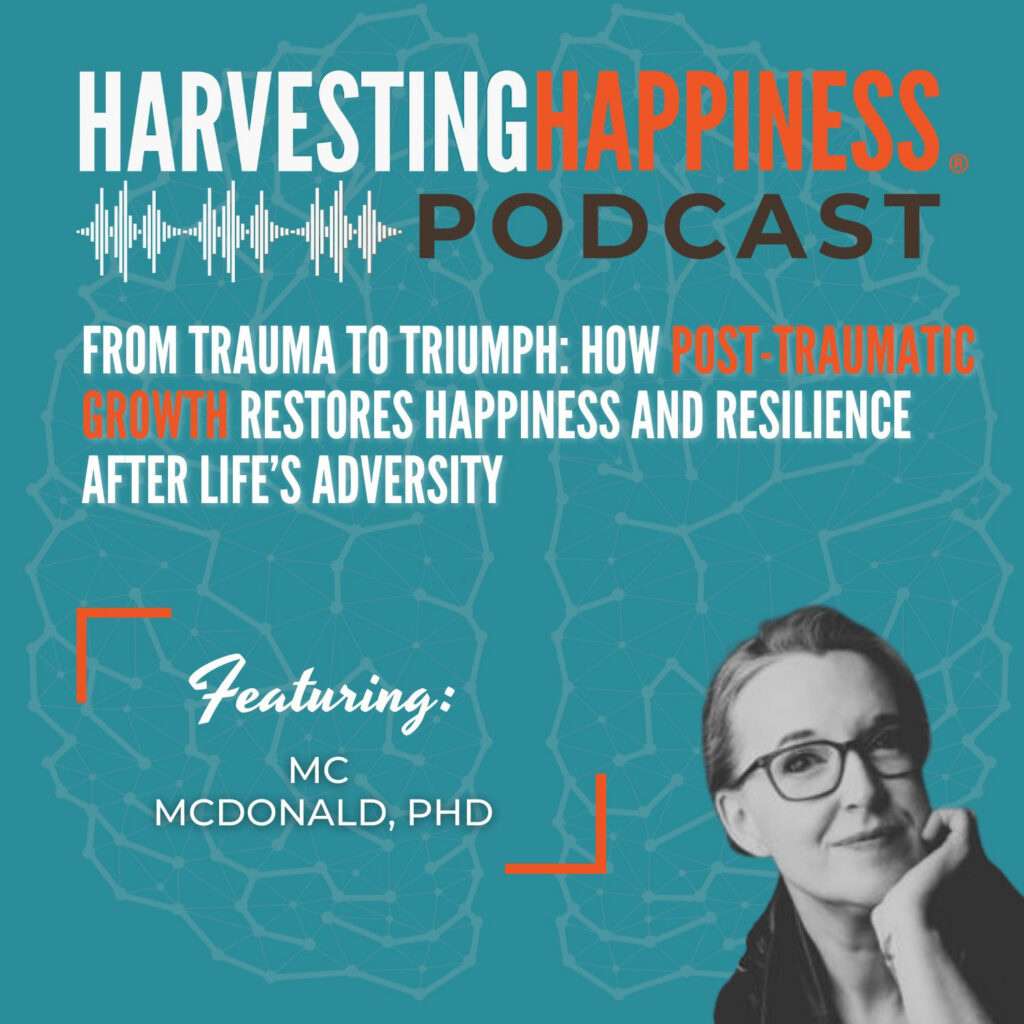
MaryCatherine (MC) McDonald, PhD, is a research professor and life coach specializing in trauma psychology and philosophy. Since 2009, she has published, taught, and coached on the neuroscience and lived experience of trauma, working to destigmatize mental health and reframe how we understand healing.
She holds degrees from The New School and Boston University and is the author of two books on trauma. Her coaching and curriculum development support veterans and formerly incarcerated individuals nationwide.
Book: The Joy Reset: Six Ways Trauma Steals Happiness and How To Win It Back
Keep Reading:

Lisa Cypers Kamen is a lifestyle management consultant who explores the art and science of happiness in her work as a speaker, author, and happiness expert. Through her globally syndicated positive psychology podcast, books, media appearances, and documentary film, Kamen has impacted millions of people around the world.
About The Author
learn more
browse services