

What your brainstem and Lao Tzu have been trying to tell you. (You weren’t listening.)
I have a confession. As the chief felicitator at Harvesting Happiness for decades, I spent a good portion of the past year in a season that felt like anything but. Grief has a particular talent for making the glass look not just half empty but cracked, tilted, and leaking onto the counter. Anxiety is that uninvited houseguest who doesn’t pick up after itself. It moves in and rearranges the furniture without permission. My focus scattered like startled birds. Sleep got complicated. And the practiced optimism that had always felt like a natural default started to feel like a performance I was no longer convincingly delivering, even to myself. In short, my mood regularly sucked.
I’m sharing this not for sympathy, but because I suspect you know the feeling. My curiosity is the ally that helped me find my way back, and it was an unexpected pairing: a 2,500-year-old Chinese philosophy and a cluster of neurons in the brainstem.
Your Brain Is an Editor, Not a Camera
Meet the Reticular Activating System (RAS). The RAS is a network of neurons tucked in the brainstem that acts as our brain’s master filter. Every second, our senses are receiving roughly 11 million bits of information. Our conscious mind processes about 40 of them. The RAS decides which 40 make the cut, and it doesn’t choose randomly. It surfaces what we’ve trained it to find: our beliefs, our fears, and our dominant inner weather. Point it at gratitude, and it will find evidence of abundance. Leave it unsupervised during a year of loss, and it will, with heartbreaking efficiency, find evidence of more loss.
That’s not pessimism. That’s not a character flaw. That is a very loyal neurological assistant doing exactly what it was programmed to do. The problem is that grief and anxiety are terrible programmers. They set the RAS to threat-detection mode and forget to mention that the crisis has passed — or at least, that it isn’t the only thing happening.
In my own year of loss, I watched this play out in real time. The hypervigilance. The way a quiet afternoon could feel charged with the static of what was missing. The RAS, doing its job, delivering exactly what I’d unconsciously asked for: more evidence that the world had contracted.
The RAS doesn’t filter out what’s unimportant. It filters out what we haven’t told it to notice. Our attention is the assignment editor of our mind — and in hard seasons, that editor needs a new brief.
Enter the Taoists, Who Figured This Out Without an fMRI
Taoist philosophy is rooted in the Tao Te Ching, the ancient Chinese text attributed to the sage Lao Tzu, and has been quietly describing RAS mechanics for millennia, just with considerably better poetry and no peer review process. The central concept of wu wei, often translated as effortless action or non-striving, is essentially a 2,500-year-old instruction for attentional hygiene. Stop gripping. Stop forcing perception forward by its collar. Let awareness arise rather than manufacture it.
Here’s the thing that stopped me cold when I encountered the scholarship of Dr. Robin Wang, remarkable Harvesting Happiness podcast guest: the Taoist insight isn’t that we should try harder to be present. It’s that the trying is the problem. The harder we strain toward joy, the more the effort itself narrows the field of view. The Tao that can be forcefully grasped, Lao Tzu writes, is not the eternal Tao. Modern neuroscience, in its more clinical way, agrees entirely: hypervigilant, focused attention narrows the perceptual field. Soft, open, receptive awareness, or the wu wei of simply noticing, is precisely when the RAS loosens its grip on the perceived threat-bias and begins letting in more of what’s actually present.
Then there is pu, which is the uncarved block — Taoism’s image of the mind before it accumulates the dense layering of fear, reactivity, and the editorial opinions of a very hard year. Returning to pu isn’t a call to naivety or spiritual bypassing. It’s an invitation to clear the filter. To remember that the original mind — before the grief and anxiety moved in and reprogrammed the RAS — was capable of perceiving a much wider world.
The Taoists and the neuroscientists are pointing at the same river. One calls it the Tao. The other calls it flow state. Both agree: you cannot force your way there, and the trying is what keeps us from floating with the current.
About That Glass
So here’s the reframe we’ve come to love: the question was never half full or half empty. Water, Lao Tzu’s favorite metaphor for the Tao, the thing that yields to everything and outlasts everything — doesn’t ask what percentage of the container it currently occupies. It takes the shape it’s given. It keeps moving. It finds its level without forcing the issue. The glass, the water, the air above the waterline — all of it, together, is the whole thing. Asking which half matters is a very human, very anxious, very RAS-in-threat-mode kind of question.
When I stopped trying to argue my RAS into positivity and started, slowly and imperfectly, practicing the Taoist art of showing up to what is — grief included, anxiety duly noted, some mornings still pretty rough…something shifted. Not dramatically. Not with a cinematic score. More like the way water finds its level: quietly, without announcement, and in the direction of least resistance.
This is a work in process. Probably always will be. The glass sits on the desk either way. But I have stopped interrogating it, and honestly, it seems relieved.
The Tao doesn’t send invitations. I do. Join me in the radical, quietly rebellious act of showing up to what is — no doing, no fixing, no judging. Just being. And please, let me know how it goes.
Resources for Further Exploration
- Tao Te Ching by Lao Tzu — Stephen Mitchell translation recommended for accessibility and elegance
- Taoism: An Essential Guide by Eva Wong — grounding overview of Taoist history and practice
- The Way of Chuang Tzu by Thomas Merton — a contemplative Western lens on Taoist thought
- Flourish by Martin E.P. Seligman — foundational positive psychology research including gratitude and attention
- The Happiness Advantage by Shawn Achor — accessible exploration of how brain priming shapes perception
- Why Zebras Don’t Get Ulcers by Robert Sapolsky — science of stress, the nervous system, and attentional narrowing
- Yinyang: The Way of Heaven and Earth in Chinese Thought and Culture by Dr. Robin Wang — Professor of Philosophy, Loyola Marymount University; leading Western scholar of Daoist philosophy
Like what you’re reading? Want more consciously prepared brain food? Listen to this Harvesting Happiness episode: The Taoist Path to Joy: Finding Flow and Freedom with Dr. Robin Wang, PhD or wherever you get your podcasts.
Get More Mental Fitness bonus content by Harvesting Happiness on Substack and Medium.
Meet Our Guest:
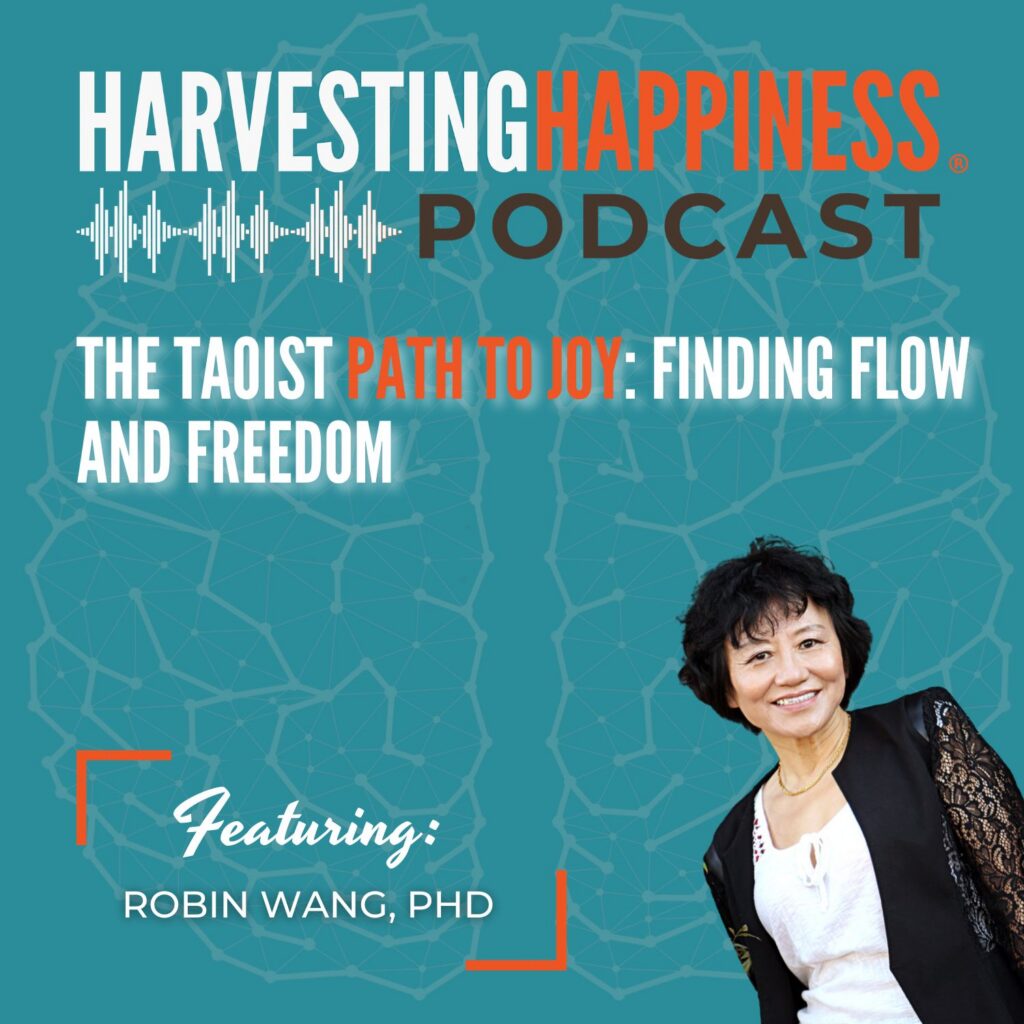
Dr. Robin R. Wang, PhD, is Professor of Philosophy at Loyola Marymount University, Los Angeles, and a past Berggruen fellow at The Center for Advanced Study in the Behavioral Sciences (CASBS), Stanford University. Her teaching and research focus on Chinese and Comparative Philosophy, particularly Daoist philosophy, as well as the intersections of women and gender in Chinese thought and culture.
She has published a wide range of essays that bridge classical Taoist philosophy with modern philosophical discourse, offering critical insights into their relevance in addressing contemporary global challenges.
Book: Yinyang: The Way of Heaven and Earth in Chinese Thought and Culture
Keep Reading:

Lisa Cypers Kamen is a lifestyle management consultant who explores the art and science of happiness in her work as a speaker, author, and happiness expert. Through her globally syndicated positive psychology podcast, books, media appearances, and documentary film, Kamen has impacted millions of people around the world.
About The Author
learn more
browse services