

What does the science of altruism actually tell us about inner peace? A look at the research on empathy, giving, and why helping others may be one of the most reliable paths to well-being.
I was not raised in a particularly emotionally generous or philanthropic home. Yes, my basic needs were met, and social skills were taught. My mother bestowed upon me a great gift by sending me to sleepaway camp when I was five. It was there I learned the “Golden Rule”: treat others as I wish to be treated, only do it first. Thank you, Grant Gerson and Calamigos Star C Ranch! This became a seminal reference point for my life.
Most of us were raised on the idea that generosity is a “nice-to-have” — something for the especially patient, the especially wealthy, the especially good.
We’ve felt that assumption ourselves, on the days we were too tired, too stretched, too depleted to give one more thing to anyone. But somewhere along the way, many of us have also had the opposite experience: the day we showed up for someone else when we had nothing left to give, and somehow walked away fuller than we started.
This contradiction is worth sitting with, because the science of altruism suggests it isn’t a contradiction at all. Helping others isn’t just an add-on to a well-lived life. It’s wired into who we are and may be one of our most reliable paths to inner peace.
We know this distinction in our bodies before we ever learn the vocabulary for it: the difference between empathy and altruism. We’ve all felt empathy curdle into something heavy and stuck — doom-scrolling through someone else’s crisis, absorbing the weight of it, feeling worse and doing nothing. And we’ve all felt what happens when that same feeling finds somewhere to go — when we pick up the phone, show up at the door, write the check, sit with the person. Altruism is empathy that has found somewhere to go. Learning to make that shift, again and again, is often the difference between compassion that sustains us and compassion that quietly burns us out.
Many of us have also lived the volunteering paradox: we give our time expecting it to cost us something, and instead it gives something back. That’s not just anecdotal. It’s one of the more consistent findings in well-being research — that regular volunteers report real emotional and psychological benefits, benefits that tend to grow even more pronounced in our hardest seasons of grief and loss. We’ve watched friends get through the worst year of their lives partly by showing up for someone else’s. Service isn’t only something we do for others. It does something for us — it gives shape and direction to feelings that might otherwise curdle into helplessness.
There’s a longer arc here too, one many of us sense intuitively long before any study confirms it: that a life organized around giving tends to feel more meaningful, and meaning is one of the sturdiest things we can hold onto when everything else feels uncertain. Purpose doesn’t just feel good in the moment. It seems to carry us through some of life’s hardest chapters.
None of this means self-care doesn’t matter, or that boundaries are optional — we’ve all learned the hard way that altruism without structure burns us out fast, and we owe ourselves better than that. But it does suggest that the old idea of generosity as self-sacrifice may have it backwards. Giving well, with intention, may be one of the more direct routes to the inner peace so many of us are chasing.
Recently, I had the privilege of taking a deeper dive into this territory in a recent Harvesting Happiness podcast conversation with Dr. Stephen G. Post, founding president of the Institute for Research on Unlimited Love, whose four decades of research have helped shape much of what we now understand about the science of altruism. It’s Part 1 of a two-part series; Part 2, Sustaining Compassion in Difficult Times, picks up where this leaves off — how do we keep that generosity alive without burning out?
Like what you’re reading? Want more consciously prepared brain food?
Listen to the full conversation on Harvesting Happiness: Unlimited Love Part I: Science and the Path to Inner Peace with Dr. Stephen G Post, PhD or wherever you get your podcasts.
Enjoying this theme? Be sure to also check out Unlimited Love Part 2: Sustaining Compassion in Difficult Times with Dr. Stephen G. Post, PhD
Resources for Further Exploration:
- Pure Unlimited Love: Science and the Seven Paths to Inner Peace by Stephen G. Post, PhD (foreword by His Holiness the Dalai Lama) — Silver Winner, 2026 Nautilus Book Awards
- Unlimited Love: Altruism, Compassion, and Service by Stephen G. Post, PhD
- The Institute for Research on Unlimited Love — research archive and papers on love, altruism, and well-being
- Podcast: The Daily Helping — “Science Can’t Measure Love,” Part 1
- Podcast: Being Human with Richard Atherton — “Pure Unlimited Love”
Meet Our Guest:
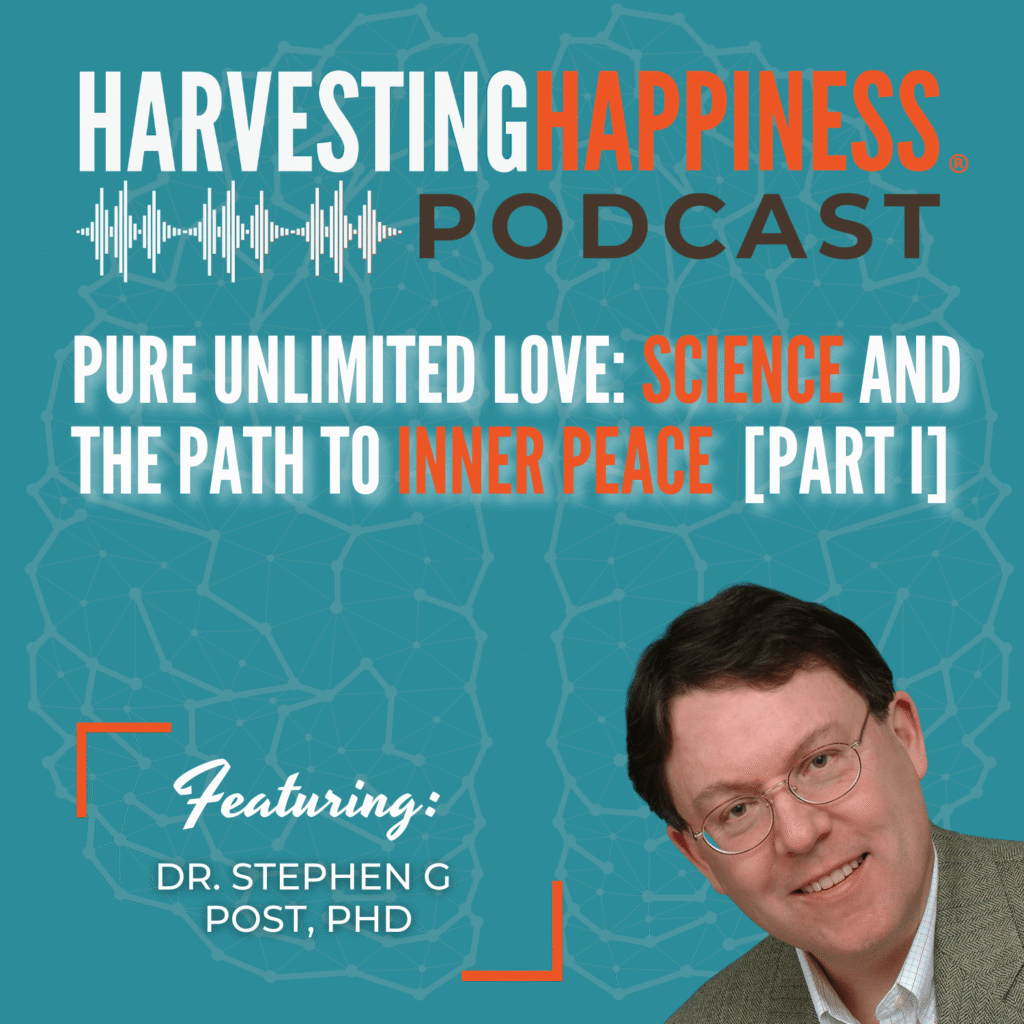
Dr. Stephen G. Post, PhD, is the Founding Director of the Center for Medical Humanities, Compassionate Care, and Bioethics at Stony Brook University Renaissance School of Medicine, where he also serves as Professor of Family, Population, and Preventive Medicine. Post has also taught at the University of Chicago Medical School and Case Western Reserve University School of Medicine.
He is an elected Member of the Medical and Scientific Advisory Board of Alzheimer’s Disease International and a widely respected opinion leader, speaker, and best-selling author.
Book: Pure Unlimited Love: Science and the Seven Paths to Inner Peace
Keep Reading:

Lisa Cypers Kamen is a lifestyle management consultant who explores the art and science of happiness in her work as a speaker, author, and happiness expert. Through her globally syndicated positive psychology podcast, books, media appearances, and documentary film, Kamen has impacted millions of people around the world.
About The Author
learn more
browse services