

Managing discord isn’t about surrendering our values — it’s about refusing to let the fight for morality become a war on each other.
In recent years, many people have quietly removed chairs from their table — chairs that once held siblings, cousins, parents, and old friends. These chairs haven’t disappeared due to distance or death, but due to something even more heartbreaking — discord fueled by differing political beliefs. It’s a loss that weighs heavy on our hearts.
Nearly everyone in my orbit relates to this scenario. Who knew that beliefs and opinions could be weaponized like a nuclear bomb? And it sucks. You’re not alone in this struggle.
What used to be spirited debates over dinner have hardened into silent estrangement or wars of words. Many of us wonder why our virtuous beliefs have become such dangerous territory in our relationships. What can we do when morality itself seems to be the battleground? When political lines become personal battlefields, managing the fallout requires more than strategy — it demands compassion rooted in shared humanity. Compassion is not a luxury, it’s a necessity in these trying times.
Let’s take a stab at dissecting these divisions — not to take sides, but to find a way through understanding. Because in this era of deep polarization, the fight isn’t just political. The struggle has become deeply personal.
The Sacredness of Belief
To understand the impact of political discord in families, we must begin with the sacred role that beliefs play in our lives. Beliefs are not just opinions we hold. They are stories we’ve inherited, experiences we’ve endured, and values we’ve chosen to live by. They help us decide right and wrong, what’s worthy of protection, and who belongs in our moral circle.
In other words, our beliefs are not just what we think. They are who we think we are.
So when someone challenges our beliefs — especially deeply rooted ones — it often doesn’t feel like a simple conversation. It might feel like a personal threat. And when those challenges come from someone we love who helped shape our childhood, it can tear at the fabric of our identity and safety.
When Morality Feels Like Fighting
Many of today’s political disagreements go beyond policy or preference. They’re rooted in moral worldviews — what feels right and just. One person believes protecting the vulnerable means one thing; another thinks it means something completely different. These moral compasses don’t just point in different directions; they exist on entirely different maps.
When morality feels at stake, conversations turn into fights for righteousness. Once that fight begins, it’s no longer about persuading or listening. It’s about defending what feels sacred — often at the cost of the relationship itself.
The rise of moral polarization has redefined how we talk (or don’t talk) to each other. Where once there was a shared sense of decency, there’s now mutual suspicion. We question each other’s character, intentions, and even humanity. We label. We otherize. We unfriend. We disown. We disconnect.
It’s not just disagreement anymore. It’s division.
The Fracturing of Family
Family is supposed to be a haven of connection beyond our opinions — a place of unconditional belonging. But in today’s climate, many families are torn apart by increasingly irreconcilable political differences.
It is common to hear someone say, “I love my brother, but I can’t respect him anymore after who they voted for,” or, “I can’t even go to Thanksgiving because it turns into a shouting match about morality and patriotism.”
Respect has become conditional, and civility has been reduced to silence, distance, or surface-level conversations about the weather. The space where we once gathered now echoes with avoidance, tension, or bitter sarcasm.
Some may try to be the conversation moderator or thought police to keep the peace by not bringing up “politics,” but the silence or apparent redirection can be just as loud. It carries a message: We can’t be our whole selves around each other anymore.
How Did We Get Here?
Power dynamics in relationships often shape how conflict unfolds, especially when unresolved internal emotional baggage from the past resurfaces. Old wounds — like feeling unheard, dismissed, or controlled — can silently fuel present-day political or moral disagreements, turning external issues into deeply personal battles for validation, safety, or autonomy.
In addition, several external forces are converging to escalate this crisis:
- Media echo chambers reinforce our existing beliefs and portray the “other side” as dangerous or immoral.
- Social media algorithms reward outrage, not understanding.
- Declining trust in institutions makes it harder to agree on even basic facts.
- Fear and uncertainty — especially during times of crisis — push people to cling more tightly to their moral and political identities.
- In this environment, political identity has become more central than ever before. For many, it’s fused with morality, spirituality, and belonging. So when someone we love sees the world differently, it doesn’t just feel like disagreement — it feels like betrayal.
Facing the Divide with Courage
Here’s the hard truth: we can’t manage this level of discord with politeness alone. Avoidance isn’t a long-term solution. Pretending we don’t care about these issues only deepens the disconnection.
What we need is moral courage. We need the courage to stay in the room, even when the conversation gets tough. We need the courage to be curious instead of reactive, to ask questions and listen to the answers. Moral courage means standing up for what you believe in, but also being open to understanding why others believe what they do.
I am not suggesting that we excuse harmful views or abandon our values. It means we commit to understanding the why behind someone’s beliefs. Because often, underneath the political stance is a longing — to feel safe, seen, or valued.
Courage demands us to interrogate our own beliefs. Where did they come from? What fears or experiences shape them? Are they still serving us — or are they boxing us in? Managing discord in families is not about converting each other. It’s about reclaiming the humanity that polarization tries to erase.
A New Approach to Conversations
When it’s time to talk (and eventually, it will be), try this framework:
1. Name the Tenderness
Take a minute to acknowledge the emotional weight of the conversation. “I know this topic is hard for both of us. I don’t want to fight — I want to understand.”
2. Start with Stories, Not Stats
Instead of launching into facts, share the personal story behind your belief. Invite the other person to do the same. Stories build bridges where statistics build walls.
3. Define the Values Underneath
Ask, “What value is most important to you in this issue?” You might find common ground, even if your policies differ. For example, you may both value fairness, even if you define it differently.
4. Take Breaks When Needed
When things heat up, it’s okay to pause. Say, “I’m feeling overwhelmed. Can we come back to this when we’re both calm?”
5. Respect Boundaries
Not every relationship can handle every topic. If specific topics of conversation cause harm or retraumatization, it’s okay to set limits — with love.
Rebuilding Civility, One Relationship at a Time
Civility is not the absence of disagreement. It’s the presence of dignity, even when we disagree. It’s choosing to see the person, not just the position.
“Peace is not the absence of conflict, but the ability to handle conflict by peaceful means.” — Ronald Reagan
In fractured families, restoring civility means taking small steps: a phone call, a handwritten note, a simple gesture of goodwill. These aren’t grand political moves — they’re compassionately moral ones.
It’s also helpful to remember that people change. Just as we’ve evolved in our thinking, others can too — sometimes silently, sometimes slowly. Don’t write people off based on a set of opinions that are snapshots in time.
What’s at Stake
The cost of giving up on each other is too high. When we let beliefs destroy relationships, we lose something irreplaceable: the shared history, the laughter, the forgiveness, the support during hard times.
Managing political discord in families isn’t about winning arguments. It’s about deciding which fights are worth having — and which relationships are worth keeping.
Sometimes, the most radical act of morality isn’t standing your ground. It’s reaching across the divide with a heart willing to listen.
From Fighting to Finding
We are living through a time when many are disoriented, afraid, and fiercely trying to anchor themselves to something that feels true. It’s no wonder that political beliefs have become the hill some are willing to die on. But we are more than our beliefs. We are stories in progress. We are people capable of love, redemption, and deeper understanding.
Let’s not let political discord rob us of the moral imagination it takes to live and love together. Let’s remember that managing disagreement is not weakness — it is wisdom. And perhaps the next time we sit around the table — if we’re brave enough to invite each other back — we’ll find something even more valuable than agreement: the strength to stay connected in a divided world.
Like what you’re reading? Want more consciously prepared brain food?
Listen to this Harvesting Happiness episode: Managing Political Discord: Morality, Fighting, and the Path to Understanding with Kurt Gray PhD or wherever you get your podcasts.
Meet Our Guest:
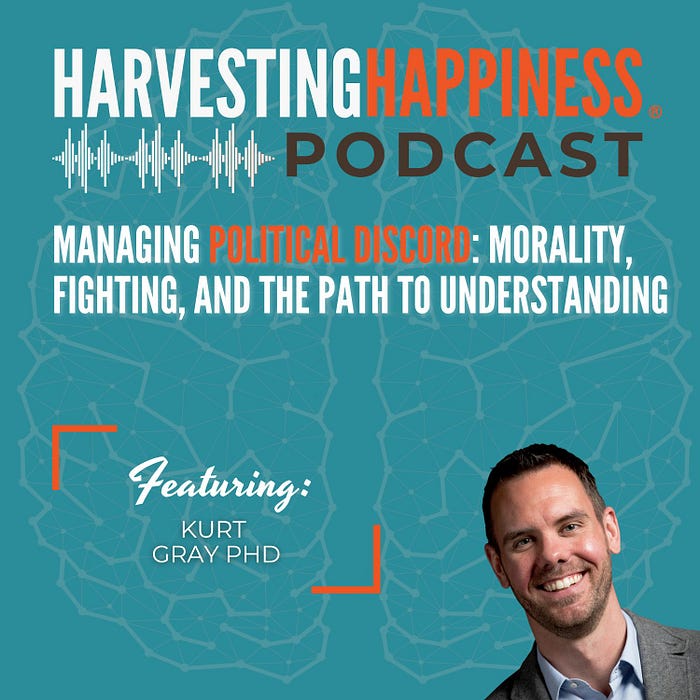
Social Psychologist Kurt Gray, PhD, is an award-winning researcher and teacher. He uses interdisciplinary methods to study people’s deepest held beliefs and ways to bridge moral divides.
He is an Associate Professor in Psychology and Neuroscience at the University of North Carolina at Chapel Hill, where he directs the Deepest Beliefs Lab and the Center for the Science of Moral Understanding. Kurt is also an adjunct associate professor of organizational behavior at the Kenan-Flagler Business School at UNC, where he teaches about organizational ethics and team processes.
Book: Outraged: Why We Fight About Morality and Politics and How to Find Common Ground
Keep Reading…

Lisa Cypers Kamen is a lifestyle management consultant who explores the art and science of happiness in her work as a speaker, author, and happiness expert. Through her globally syndicated positive psychology podcast, books, media appearances, and documentary film, Kamen has impacted millions of people around the world.
About The Author
learn more
browse services