

This is Part 2 of a two-part series. In Part 1, we explored why caring is essential to human health and survival. Now we examine the dark forces threatening this capacity—and discover pathways to reclaim it.
As I wrote in Part 1, caring is not a luxury—it’s a biological and psychological necessity. But something deeply troubling is happening in our society. I’m witnessing fear operate as a social contagion that’s systematically dismantling our capacity to care, creating what I call an “anti-social culture” where empathy itself becomes dangerous.
Enforced Apathy Through Emotional Contagion
What fascinates and troubles me is how fear doesn’t just spread—it mutates into increasingly restrictive behavioral norms that attack our capacity to care. I’m watching a form of social extortion unfold where caring about “the other” becomes genuinely dangerous to one’s social standing.
When one person in a group expresses empathy across tribal lines and faces immediate punishment—exclusion, mockery, accusations of betrayal—everyone else observes and learns. This is a classic example of observational learning, but it teaches us to suppress our prosocial instincts rather than express them.
What’s particularly insidious is how this creates a deep sense of personal unworthiness: “If I care about them, I will be considered disloyal or weak—and unworthy of being cared about.” The fear isn’t just about external consequences—it’s about internalizing the belief that our compassionate impulses—the very qualities that make us healthy, connected humans—make us unworthy of belonging.
The “Not My Problem” Stance Is Making Us Sick
What strikes me most is how apathy spreads with the same viral mechanics as compassion—but often more efficiently. When we observe others in our group successfully avoiding the emotional labor and social risk of caring about outsiders, it provides a model for self-protection. I see people adopting this defensive indifference not through careful consideration but through emotional osmosis.
One person’s “I don’t care about that issue” provides permission for the next person’s disengagement, and soon you have entire communities anesthetized against empathy for anyone outside their circle. In this anti-social culture, caring becomes increasingly expensive—not just socially, but also psychologically.
“It’s in our interest to take care of others.
Self-centeredness is opposed to basic human nature. In our own interest as human beings, we need to pay attention to our inner values.
Sometimes people think compassion is only of help to others, while we get no benefit. This is a mistake.
When you concern yourself with others, you naturally develop a sense of self-confidence. To help others takes courage and inner strength.”
– Dalai Lama
People begin to fear their capacity for empathy, wondering if their caring impulses are evidence of their unsuitability for the harsh “realities” of tribal survival. But here’s what I know from the data: every time we suppress our caring impulses, we pay a psychological price. Our sense of meaning erodes. Our stress increases. Our connections become transactional and shallow. We’re trading our humanity for tribal approval, and we’re becoming depressed, anxious, and empty in the process.
Humility Deficit and the Shame of Caring Are Interconnected.
In positive psychology, we know that intellectual humility—the ability to acknowledge we might be wrong—is foundational to well-being and healthy relationships. But I’m watching tribal dynamics actively select against humility.
When one group’s emotional climate punishes uncertainty and rewards absolute conviction, humility becomes socially expensive. Even when a confident shepherd steers the herd away from their values of compassion and openness, the sheep still follow him out of a need to belong.
What concerns me deeply is how the herd mentality creates what I call “empathy shame”—people feel personally unworthy or inadequate when they experience compassion for those their tribe has designated as undeserving. In an increasingly anti-social culture, the natural human impulse to care is reframed as a character flaw rather than a virtue. This situation is psychologically devastating because it turns our greatest strength—our capacity for empathy—into a source of shame.
The Sheep Mentality: Survival That’s Killing What Makes Life Worthwhile
We often dismiss herd behavior as mindless conformity, but I see something more nuanced and more human. We’re seeing two basic fears clash: the immediate, visceral fear of being rejected by others and the more abstract fear of compromising one’s morals.
From the standpoint of evolutionary psychology, the fear of ostracism activates the same neural pathways as physical pain. So when I watch people choose tribal loyalty over universal empathy, I’m not seeing moral failure—I’m seeing our social survival instincts overwhelming our ethical reasoning. But here’s the paradox: while we’re protecting ourselves from tribal rejection, we’re simultaneously destroying the caring connections that provide life meaning and keep us psychologically healthy.
We’re choosing a form of survival that makes us sick, isolated, and despairing. We’re sacrificing the very thing—caring relationships—that research shows is the single greatest predictor of human happiness and longevity.
The Psychological Autoimmune Disorder
Unlike threats that unite us in collective resilience—what we call “tend and befriend” responses—this fear divides by weaponizing our deepest need for belonging. I’m observing a kind of psychological autoimmune disorder at the societal level. The very systems designed to protect us—our tribal bonds, our capacity for group loyalty, our sensitivity to social cues—are now attacking our healthiest impulses toward universal compassion and empathy.
The anti-social culture perpetuates the belief that caring is a sign of weakness, empathy is a potential source of exploitation, and extending oneself beyond one’s immediate tribe is a sign of foolishness. This creates an agonizing internal conflict where people experience their most humane qualities—their capacity for compassion—as evidence of personal unworthiness or failure to adapt to “reality.”
From a well-being perspective, such behavior is catastrophic. We’re teaching people to fear and suppress the very capacity that creates meaning, connection, health, and happiness. We’re making ourselves sick by rejecting our own nature.
What Gives Me Hope: Making Caring Contagious Again
From a positive psychology perspective, here’s what gives me hope: Emotions are contagious in both directions.
The same social transmission mechanisms that spread fear can spread courage, empathy, and what I call “rebellious compassion”—the brave choice to care across tribal lines despite social cost.
Every person who breaks the herd mentality and expresses genuine concern for “the other” creates a new model for others to follow. We know from research on moral exemplars that it only takes a few courageous individuals to shift group norms. When someone dares to care publicly and doesn’t collapse under the weight of unworthiness, they give others permission to reclaim their humanity and compassion.
They demonstrate that caring doesn’t make us weak or foolish—it makes us human, healthy, and whole. In an anti-social culture, every act of genuine empathy is a form of resistance, a contagious reminder that our worthiness isn’t contingent on hardening our hearts.
The Path Forward: Creating Spaces Where Caring Is Celebrated
We need to create spaces—in families, workplaces, communities, and online—where caring is celebrated rather than punished. We need to model vulnerable compassion, demonstrating that we can care deeply while also setting boundaries and taking care of ourselves.
We need to tell stories that honor caregivers, that show the strength in empathy, and that remind us why connection matters more than winning. We need to practice what I call “strategic tenderness”—bringing softness and care to interactions even when it feels risky, knowing that we’re planting seeds that may grow into new norms.
Most importantly, we need to remember this truth: caring is not a sign of weakness. It’s the source of everything that makes life worth living—love, purpose, meaning, connection, growth, and joy. When we care, we don’t lose ourselves—we find ourselves. We become who we were always meant to be.
The Question We Must Answer Together
How do we create conditions where caring becomes as contagious as fear, where empathy feels safer than apathy, where people can reclaim their compassion without experiencing shame or unworthiness, and where the herd instinct moves us toward connection rather than division?
“I choose bold. I choose action. I choose what’s right for the people. I choose to make a difference.”– Bill Richardson
How do we remind each other that caring—for others and ourselves—isn’t just good, it’s essential. It’s what makes us human. And it’s what will save us.
Continue the conversation: Share your experiences with practicing caring in challenging times. How have you witnessed empathy spreading—or being suppressed—in your communities?
Like what you’re reading? Want more consciously prepared brain food?
Listen to this Harvesting Happiness episode: Culture Shock: How Big Tech’s Digital Colonialism Imposes Values on the World with Katharina Reinecke PhD or wherever you get your podcasts.
Get “More Mental Fitness” bonus content by Harvesting Happiness on Substack and Medium.
Meet Our Guest:
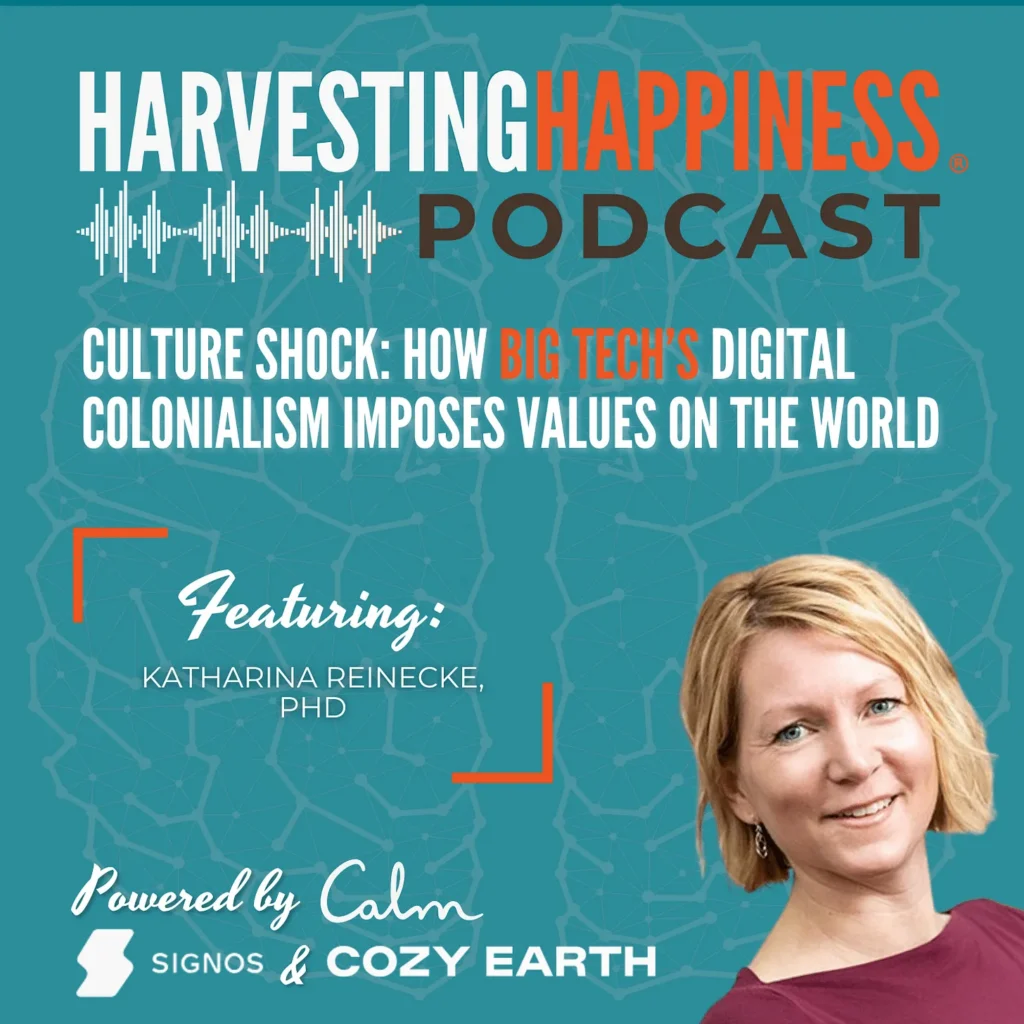
Katharina Reinecke, PhD is a professor at the University of Washington’s Paul G. Allen School of Computer Science & Engineering and director of the Interdisciplinary UW Center for Globally Beneficial AI.
She is a co-founder of LabintheWild, a platform for online research studies with participants from around the world, and the author of “Digital Culture Shock: Who Creates Technology and Why This Matters.”
This episode is proudly sponsored by:
- Calm—Offers the #1 app for sleep and meditation. Download Calm and find a place made just for you to rest. Visit Calm.com/HHTR. Listeners get 40% off a Calm Premium Subscription.
- Signos—Offers the world’s first FDA-cleared AI-driven app and CGM for weight management and wellness that turns data into lasting habits for better health. Visit Signos.com and use promo code HHTR to get $10 off select plans.
- Cozy Earth — Offers luxury loungewear, premium pajamas, and essential home goods. Visit CozyEarth.com and use promo code HHTR to get up to 40% off your order.
Resources for Further Exploration
Books:
- The Upward Spiral by Alex Korb – Neuroscience-based insights on how small positive actions create lasting change
- Self-Compassion by Kristin Neff – Research and practices for developing self-kindness
- Born to Be Good by Dacher Keltner – The science of human goodness and compassion
- The Village Effect by Susan Pinker – How face-to-face contact shapes our health and happiness
- Bowling Alone by Robert Putnam – The collapse and revival of American community
Research & Organizations:
- Greater Good Science Center (UC Berkeley) – Research-based insights on compassion and altruism
- Center for Compassion and Altruism Research and Education (Stanford University)
- The Empathy Lab – Resources for developing empathy skills
- Mind & Life Institute – Contemplative science and compassionate action
Keep Reading:

Lisa Cypers Kamen is a lifestyle management consultant who explores the art and science of happiness in her work as a speaker, author, and happiness expert. Through her globally syndicated positive psychology podcast, books, media appearances, and documentary film, Kamen has impacted millions of people around the world.
About The Author
learn more
browse services