


If we are breathing, life’s inevitable challenges create waves of disappointment, anxiety, and depression; most people instinctively turn to traditional psychotherapy. “Help, I’m having feelings!” they cry, rushing to the nearest therapist’s couch. But wait—there’s an ancient and increasingly relevant alternative that addresses these same struggles through a fundamentally different lens: philosophical counseling. Think of it as therapy’s older, wiser sibling who quotes dead Greeks instead of asking about our childhoods.
Why Philosophy Matters for Mental Health (And Why Socrates Would Have Been Great at Parties)
The philosophical approach to mental health recognizes that many of our deepest struggles aren’t necessarily medical conditions requiring clinical intervention, but rather existential challenges that call for:
- Wisdom and reflection rather than symptom management (because sometimes the real problem is that we haven’t thought about thinking).
- Deeper understanding of life’s fundamental questions (like “Why do we exist?” or “Why did I eat that entire bag of chips?”).
- Examining the foundations of how we understand ourselves (spoiler alert: we’re all winging it).
- Transforming challenges into opportunities for growth (because apparently every crisis is actually an invitation to grow in disguise—thanks, philosophy).
When disappointment strikes, anxiety overwhelms, or depression clouds our vision, philosophical counseling asks more than just, “How do we feel better?” However, the question arises: “What does this experience teach us about the human condition?” Experiencing an existential crisis feels similar, but it is presented in a more appealing way.
How Dead Philosophers Can Save Our Mental Health
Philosophy has always been intimately connected with healing the human soul. Socrates famously declared, “You will do me a much greater benefit if you were to cure my soul of ignorance than you would if you were to cure my body of disease.” (Translation: “Fix my brain, not my back pain.”)
Key Philosophical Insights:
- Root causes matter: Many psychological ailments stem from fundamental misunderstandings about life, meaning, and our place in the cosmos (turns out we’re not the center of the universe—shocking, right?).
- Natural responses: Disappointment, anxiety, and depression are natural responses to the human condition (being human is hard work; who knew?).
- Wisdom over pathology: These experiences become doorways to greater wisdom rather than disorders to eliminate (our breakdown might actually be a breakthrough in disguise).
- Focus on what we control: The Stoic tradition teaches us to accept what lies beyond our control while focusing energy on our thoughts, attitudes, and responses (basically, stop trying to control other people—they won’t listen anyway)
The philosophical framework provides a fundamentally different approach to anxiety than traditional therapeutic models, focusing on wisdom and rational understanding rather than symptom management. It’s like upgrading from “How to Feel Better Fast” to “How to Think Your Way Out of This Mess.”
Philosophical Counseling vs. Psychotherapy: The Ultimate Showdown
Understanding the distinction between philosophical counseling and psychotherapy is crucial for anyone seeking mental wellness support. It’s like choosing between a wise sage and a medical detective—both useful, but for different reasons.
Philosophical Counseling Approach:
- No medical diagnoses: Focuses on philosophical dimensions of life problems rather than behavioral disorders (no labels, just questions).
- Meaning and purpose: Addresses struggles around identity, values, and existential questions (like “Who am I?” and “Why does pineapple on pizza cause such controversy?”).
- Egalitarian relationship: Counselor serves as a philosophical companion, not a medical expert (more like a really smart friend who won’t let you make bad decisions).
- Socratic dialogue: Uses critical thinking and rational inquiry to examine beliefs (prepare to be questioned about everything you think you know).
- Wisdom-based: Views challenges as opportunities for growth and understanding (your problems are actually philosophical puzzles in disguise).
Traditional Psychotherapy Approach:
- Medical model: Views depression and anxiety as disorders requiring treatment (something is broken; let’s fix it).
- Expert-patient dynamic: The therapist diagnoses and treats the client (the doctor knows best).
- Symptom focus: Primarily concerned with reducing psychological distress (make the bad feelings go away, please).
- Therapeutic techniques: Uses established clinical interventions and protocols (there’s a method to this madness).
- Pathology-oriented: Emphasizes what’s “wrong” that needs to be fixed (what’s broken in your brain today?).
Real-World Example:
Imagine a career disappointment scenario:
- The psychotherapist might explore: How childhood patterns, attachment styles, and cognitive distortions (basically, how our parents messed us up).
- The philosophical counselor would examine: Our beliefs about success, meaning, human flourishing, and questions like “What constitutes a meaningful life?” (What if failure is actually success in disguise?).
Addressing Life’s Inevitable Challenges (Or: How to Make Friends with Your Problems)
Depression, anxiety, and disappointment are universal human experiences that no amount of positive thinking or therapeutic intervention can permanently eliminate. Sorry, Instagram motivational quotes—you’re not actually magic. The philosophical approach acknowledges this reality while offering tools for navigating these challenges with greater wisdom and equanimity.
Philosophical Approach to Anxiety:
- Examines the relationship with uncertainty and the need to control outcomes beyond our influence (spoiler: we can’t control everything, and that’s okay).
- Explores philosophical foundations of our fears about safety, success, and the future (turns out, most of our worries are just really convincing stories we tell ourselves).
- Develops a rational, peaceful relationship with life’s inherent unpredictability (embrace the chaos—it’s more fun than it sounds).
- Uses existentialist insights about anxiety as an inevitable aspect of human freedom and responsibility (we’re free to choose our response, which is both terrifying and liberating).
Philosophical Understanding of Depression:
- The episode is viewed as a crisis of meaning rather than simply a chemical imbalance (our brain isn’t broken; it’s just having an existential moment).
- The philosophical understanding of depression delves into questions of value, purpose, and authentic living, instead of concentrating solely on its symptoms.
- Applies Viktor Frankl’s logotherapy: Finding meaning and purpose even in dire circumstances (if he could uncover meaning in a concentration camp, we can locate it in our current situation).
- Emphasizes that humans can discover significance in their struggles (our pain has a point, even if we can’t see it yet).
Transforming Disappointment:
- Reveals the gap between our expectations and reality (reality has a sense of humor, and it’s not always funny).
- Examines assumptions about how we believe life “should” unfold (news flash: life didn’t get the memo about our five-year plan).
- Develops a flexible, realistic relationship with hopes and dreams.
Uses multiple frameworks:
- Buddhist concepts of attachment (clinging hurts; letting go heals).
- Stoic practice of negative visualization (imagine the worst, appreciate what we do have).
- Existentialist insights offer clarity about authenticity (be yourself; everyone else is taken).
Key insight: Rather than pathologizing these experiences, philosophical counseling views them as natural responses to the human condition that can become doorways to greater wisdom.
Please consider this—your mental meltdown might actually be a breakthrough, striving to capture your attention.
When Philosophy Isn’t Enough
It’s crucial to acknowledge that philosophical counseling isn’t appropriate for all mental health challenges. Sometimes we need actual medicine, not just ancient wisdom.
When Philosophical Counseling Works Best:
- Philosophical counseling is most effective when it addresses existential questions and life transitions, such as “What’s the point?” and “Now what?”
- Moral dilemmas and ethical concerns (when the conscience won’t shut up).
- Search for meaning and purpose (beyond money and things).
- Clarification of values and identity exploration (Who are we when no one’s watching?).
- Readiness for self-reflection and critical thinking (warning: may cause uncomfortable self-awareness)
When Traditional Therapy Is Necessary:
- Severe depression requires medical intervention (when philosophy meets its match).
- Bipolar disorder and other serious mental health conditions require professional help due to imbalances in brain chemistry.
- Schizophrenia and psychotic disorders (reality checks require medical backup).
- Emergencies necessitate prompt clinical assistance (when we require immediate assistance, not after engaging in a philosophical debate).
Important consideration: Philosophical counseling is attractive as an alternative for those who prefer to avoid the medicalization of life problems, but effectiveness depends on our readiness for intellectual engagement and willingness to question our fundamental beliefs. Side effects may include sudden clarity, uncomfortable truths, and the urge to quote dead philosophers at dinner parties.
Integration and Modern Applications
The most promising developments in mental health may come from a hybrid approach that integrates philosophical and psychological approaches rather than viewing them as competing alternatives. Having multiple tools for different situations is akin to having a versatile toolkit for your mental health.
Integrated Therapy Approaches:
Cognitive Behavioral Therapy (CBT): Examines and challenges irrational beliefs. This suggests that our thoughts may not always be accurate—let’s investigate this further.
Acceptance and Commitment Therapy (ACT): Draws heavily from philosophical traditions, particularly mindfulness and existentialist concepts (accept what is; commit to what matters).
Combined treatment models: Address both practical coping strategies and deeper existential questions (fix the immediate problem AND figure out what it all means).
Benefits of Integration:
For anxiety: Examine the philosophical foundations of our fears AND learn practical coping strategies (understand why we’re freaking out AND learn how to stop).
For depression: Explore meaning and purpose AND address underlying medical/psychological factors (find out why AND get the needed chemical help).
The hybrid approach: Combine the wisdom of philosophical traditions with the rigor of empirical psychology, merging ancient wisdom with modern science—similar to a caped superhero from mythology.
The most effective mental health support may lie in this integrated approach, offering both ancient wisdom and modern scientific understanding. Why restrict ourselves to choosing between Socrates and Prozac when we have the opportunity to benefit from both?
How to Be Your Own Philosopher
The philosophical approach to mental health offers practical tools that anyone can incorporate into their daily life. No philosophy degree is required—although proper education is always a bonus when outsourcing professional support.
Socratic Self-Questioning Techniques:
For Disappointment:
- What expectations am I holding that may be unrealistic? (Were you expecting life to be fair? That was your first mistake.)
- How might this setback serve my larger development? (Plot twist: your failure might be the best thing that ever happened to you)
- What would a Stoic philosopher say about this situation? (Probably something annoyingly wise and calm)
- What can I learn about my values from this experience? (Disappointment is a great teacher, if you’re willing to listen)
For Anxiety:
- What beliefs about control and safety am I holding? (Newsflash: control is mostly an illusion)
- What lies within my influence versus beyond it? (You can control your response, not the outcome)
- How can I embrace uncertainty as part of human freedom? (Freedom is scary – that’s what makes it freedom)
- What would happen if I accepted this unknown outcome? (Spoiler: probably nothing as terrible as you imagine)
For Depression:
- What gives my life meaning and purpose? (If you don’t know, that’s okay – that’s what the journey is for)
- How might my suffering contribute to my growth? (Pain is inevitable, growth is optional)
- What values am I not honoring in my current life? (Are you living someone else’s life by mistake?)
- Where can I find my authentic self? (Hint: it’s probably not on social media)
Building Your Personal Philosophy:
- Draw from various traditions: Stoicism, Buddhism, Existentialism, or personal insights (mix and match like a philosophical smoothie).
- Develop a coherent worldview that provides guidance during difficult times (your personal operating system for life).
- Create meaning-making frameworks for understanding life’s challenges (turn chaos into narrative).
- Practice regular reflection and philosophical contemplation (think about thinking – it’s more fun than it sounds).
Remember: The goal isn’t to eliminate discomfort but to engage with life’s challenges as opportunities for growth, wisdom, and deeper self-understanding. Embrace those sucky moments – it’s where the good stuff happens.
Choosing A Productive Path to Wellness
The choice between philosophical counseling and traditional psychotherapy isn’t necessarily an either-or decision. Both approaches offer valuable strategies for navigating life’s challenges, and many individuals benefit from incorporating elements of both. It’s like choosing between chocolate and vanilla—why not a swirl of both?
Choose Philosophical Counseling If You:
- Seek to understand struggles within a larger context of human meaning (you want the big picture, not just the quick fix).
- Want frameworks for understanding disappointment, anxiety, and depression as natural aspects of life (you’re ready to make friends with your problems).
- Prefer intellectual exploration over clinical treatment models (you’d rather think your way out than medicate your way through).
- Are prepared to examine fundamental beliefs and assumptions (warning: may cause identity crisis).
- Value wisdom traditions and philosophical insights (you enjoy conversations with dead philosophers).
Consider Traditional Therapy If You:
- Need clinical diagnosis and treatment for severe conditions (when your brain needs medical backup).
- Require crisis intervention or immediate symptom relief (when you need help RIGHT NOW).
- Prefer structured therapeutic techniques and protocols (you like your help with a side of science).
- Want empirically-validated treatment approaches (you trust research more than ancient wisdom).
As Plato noted, “To wonder is the mark of the philosopher.” Perhaps our greatest life questions and struggles with mental health are invitations to wonder more deeply about:
- The nature of human existence (spoiler: it’s complicated)
- The meaning of suffering (plot twist: it might actually have a point)
- The possibility of wisdom and growth (your pain might be your teacher in disguise)
The philosophical path to mental wellness doesn’t promise easy answers or quick fixes. Instead, it offers something more valuable: the tools to engage with life’s challenges as opportunities for transformation and insight. There are no magic pills involved, only thoughtful, open-ended questions to consider.
In a world that often seeks to medicate away discomfort, the philosophical approach reminds us that some forms of suffering carry within them the seeds of profound transformation and understanding. Your breakdown might actually be your breakthrough’s awkward cousin—embrace them both.
Like what you’re reading? Want more consciously prepared brain food?
Listen to this Harvesting Happiness episode: Philosophically Dealing with Depression, Anxiety, and Disappointment with Samir Chopra, PhD or wherever you get your podcasts.
Get More Mental Fitness bonus content by Harvesting Happiness on Substack and Medium.
Meet Our Guest:
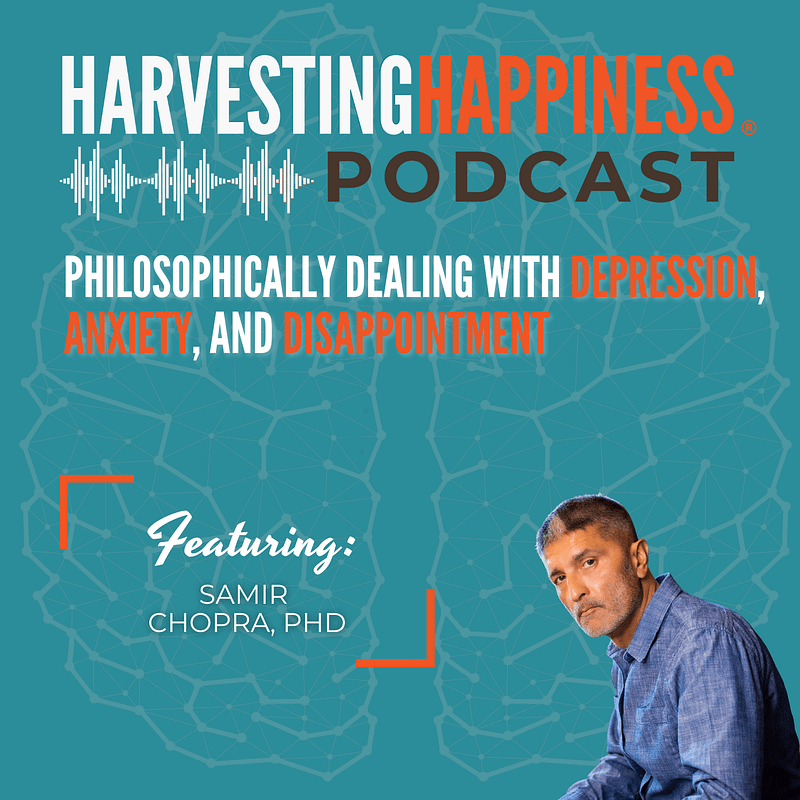
Samir Chopra, PhD, is a philosophical counselor and professor emeritus of philosophy at Brooklyn College and the Graduate Center of the
City University of New York. He has authored and co-authored several books, including works on film, artificial intelligence, and sports.
Samir is a proponent of critical thinking who helps others manage anxiety and improve their mental health through a philosophical approach. Samir’s latest book is “Anxiety: A Philosophical Guide”
Disclaimer: This communication is for information only and does not constitute mental health treatment or indicate a therapeutic relationship. Individuals in need of treatment for mental health or psychological concerns should seek services from appropriate mental healthcare professionals.
References:
- Costello, S. J. (2014). Saturday with Socrates: Philosophy, Therapy and Mental Wellbeing. Retrieved from https://drstephenjcostello.wordpress.com/2014/03/24/saturday-with-socrates-philosophy-therapy-and-mental-wellbeing-stephen-j-costello/
- Curious Soul Philosophy. (2025). How Is Philosophical Counseling Different From Psychotherapy? Retrieved from https://www.curioussoulphilosophy.com/newsblog/how-is-philosophical-counseling-different-from-psychotherapy/
- Wikipedia. (2025). Philosophical counseling. Retrieved from https://en.wikipedia.org/wiki/Philosophical_counseling
- Listening.com. What is Philosophical Counseling? Retrieved from https://www.listening.com/blog/philosophical-counseling
Keep Reading…

Lisa Cypers Kamen is a lifestyle management consultant who explores the art and science of happiness in her work as a speaker, author, and happiness expert. Through her globally syndicated positive psychology podcast, books, media appearances, and documentary film, Kamen has impacted millions of people around the world.
About The Author
learn more
browse services